

You prepared a harness for your cat to prevent them from escaping during disasters or vet visits, but when you put it on them...
- They "flop" over and stop moving.
- They lower their center of gravity and crawl slowly.
- They freeze like a stone and don't budge an inch.
Have you ever experienced anything like that?
It's too early to give up and think, "Maybe it just didn't work for my cat!" The phenomenon of cats freezing when wearing a harness can actually be solved by choosing the right harness material and practice.
This article will explain why cats dislike harnesses, how to choose a stress-free harness, and a fun "3-step training method" you can do at home.
Why do cats "freeze" when they wear a harness?

Why do cats freeze and become immobile as soon as they put on a harness? Let's consider what might be going through their minds.
They misunderstand it as being "caught!"
A cat's body, especially their back and flanks, is very sensitive. Furthermore, the sensation of being firmly pressed on the back is similar to being "caught by a predator." When a harness is put on them, they stop moving as an instinctive defensive reaction.
Weight and discomfort are stressful
A cat's fur also acts as a sensor. So, having something attached to their body is more stressful for a cat than you might imagine. If they're not used to a harness, they might feel like "there's something strange on my body..." and won't be able to walk as usual.
Fear from being forced to wear it
If a cat has a bad experience the first time they wear a harness, they learn that "harnesses are scary." Cats are very quick learners, so subsequent training can become difficult.
How to choose stress-free materials

To ensure your cat can wear a harness without stress, choosing the right harness is paramount. There are three key points to check when selecting a harness:
1. Prioritize "lightness" above all else
While dog harnesses might seem interchangeable, they are often too heavy for cats. Harnesses with large metal fittings or excessive decorations are not suitable for cats. It's crucial to choose one that prioritizes "lightness."
2. Choose materials that are "soft and gentle on the skin"
Hard nylon or leather straps can irritate a cat's delicate fur and skin. We recommend organic cotton or polyester cotton, which are soft to the touch and breathable. Choose a material that has minimal stiffness and friction and feels soft.
3. "Vest-type" for broad support
String-type harnesses can dig in or feel restrictive, and they are also easier to slip out of. A "vest-type" harness that gently wraps around the body tends to reduce the feeling of being "caught."
Take your time! The 3-step training method you can do at home

It's a no-go to buy a harness and immediately put it on your cat. Take it at your cat's pace and proceed with the basic habituation method of small steps.
Step 1: First, let them get used to its "presence"
First, it's important not to let the harness seem like something "scary." Once you've bought the harness, leave it on your cat's blanket or bed for a few days.
At this stage, there's no need to try putting it on yet. The main goal is for them to get used to the harness's presence and smell.
Step 2: Try wearing it "loosely" indoors
Once they're used to the smell, it's time to practice wearing it. The key here is to start by simply "placing it on" and gradually progress.
First, place the harness on their back. While it's there, give them treats. Repeat this several times, and if they seem okay, try putting their arms through the harness or fastening the hook-and-loop closure (Velcro) or buckle on their back. It's fine for it to be loose at first.
Step 3: Do "fun things" while wearing it
Once your cat can wear the harness without freezing, gradually extend the time they wear it.
Try playing with a wand toy or their favorite toy while they're wearing the harness. While they're engrossed in play, they'll forget the discomfort of the harness. If you can create a positive association that wearing the harness means fun things happen, it's a huge success.
It's also important to return to Step 1 or 2 without rushing.
If your cat flops over mid-training, don't force them to stand up. Instead, entice them with treats or toys. If they still don't move, return to Step 1 or 2. The same applies if they get upset and struggle; patience is key.
Pursuing ultimate comfort! Poponeko's cat harness

Many cat owners worry, "It's hard to find a harness that meets the criteria..." or "I'm worried if it's soft, it might slip off..."
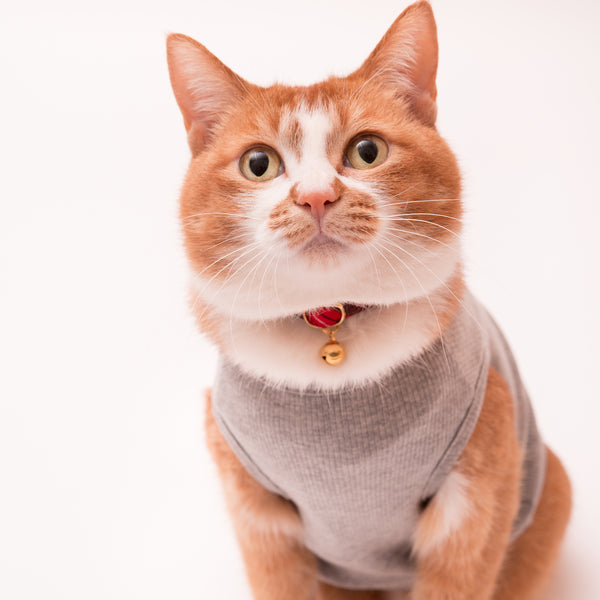
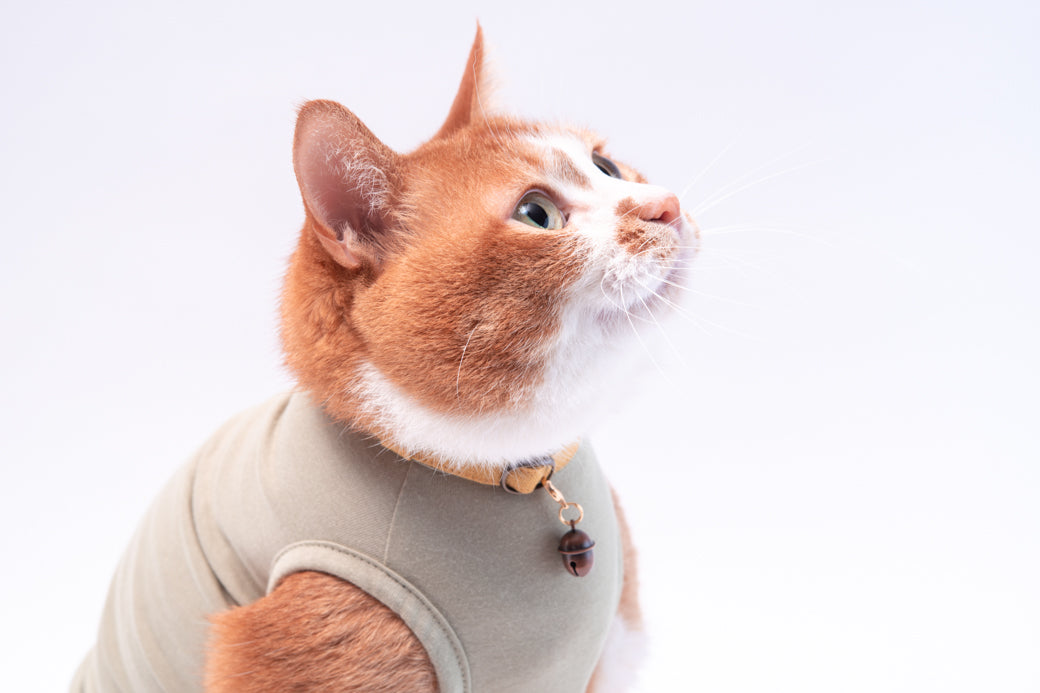
We wanted to create a harness that could be used with more peace of mind. With that in mind, Poponeko developed the "cat-friendly vest-type harness."
Surprising "lightness" and "softness"
To reduce the burden on cats, we thoroughly researched cat skeletons and movements. Then, by focusing on carefully selected domestic fabrics, we completed Poponeko's "cat-friendly vest-type harness."
The part that touches the cat's skin is as soft as underwear and designed to be weightless, so we've received happy comments like, "My cat used to freeze with other harnesses, but they can walk with this one!"
"Double block" structure that prevents slipping off
We've also addressed the concern, "If it's soft, won't it slip off easily?" The hook-and-loop fasteners (Velcro) ensure a snug fit, securely holding the body. The structure makes it difficult to slip off even with a cat's characteristic "backing up" movement.
Handmade by Japanese craftsmen
Because it touches a delicate cat's skin, we paid close attention to the stitching. Fasteners and tags are designed not to irritate the skin, and each item is carefully finished by craftsmen.
Summary

When a cat freezes up while wearing a harness, it's mostly due to issues with the harness's comfort or their familiarity with it.
- Choose a light and soft vest-type harness.
- Start by letting them get used to its "presence" without forcing it.
- Do "fun things" while they're wearing the harness.
Keep these three points in mind and practice slowly, without rushing.
If a harness becomes a "comforting item" for your cat, it will surely become a "charm" that protects them in the event of a disaster or during vet visits. If you don't want to compromise on both your cat's comfort and safety, please check out the details.



![[Set] Leaf Ribbon & Scrunchie Cat Collar - Champ de Fleurs Blue](http://www.poponeko.jp/cdn/shop/files/DSC00087_94f6c056-010c-400c-bd97-b15ffaf7d230.jpg?v=1780663183&width=600 "[Set] Leaf Ribbon & Scrunchie Cat Collar - Champ de Fleurs Blue")
![[Set] Leaf Ribbon (Moda Agatha Road) & Cat Collar (MUJI Belgian Linen Orange)](http://www.poponeko.jp/cdn/shop/files/260618_00169.jpg?v=1784451812&width=600 "[Set] Leaf Ribbon (Moda Agatha Road) & Cat Collar (MUJI Belgian Linen Orange)")
![[Set] Leaf Ribbon & Cat Collar - Arabesque Swirl, Red](http://www.poponeko.jp/cdn/shop/files/2608_00117.jpg?v=1789044775&width=600 "[Set] Leaf Ribbon & Cat Collar - Arabesque Swirl, Red")
![[Set] Leaf Ribbon "Fleurage" Pink & Scrunchie Cat Collar "Belgian Linen" Wine Rose](http://www.poponeko.jp/cdn/shop/files/2608_00132.jpg?v=1789197487&width=600 "[Set] Leaf Ribbon \"Fleurage\" Pink & Scrunchie Cat Collar \"Belgian Linen\" Wine Rose")
![[Set Item] Leaf Ribbon & Cat Collar, Petit Fleur, Pink](http://www.poponeko.jp/cdn/shop/files/2608_00405.jpg?v=1789946167&width=600 "[Set Item] Leaf Ribbon & Cat Collar, Petit Fleur, Pink")
Leave a comment