

February has arrived, and for those who suffer from hay fever, it's about to be a headache-inducing season.
This winter, in particular, is said to be warmer than usual, and pollen is also said to be appearing earlier than in previous years. Hay fever is a very unpleasant condition for people, but do cats also suffer from it? This time, we'll explain hay fever.
What exactly is hay fever?

Hay fever is an allergic reaction to pollen. In humans, Japanese cedar and cypress are typical examples.
Allergies are classified into types I to IV, with hay fever being a Type I allergy. Type I allergies are also known as immediate hypersensitivity reactions, and allergic symptoms appear within a few hours of pollen entering the body.
To explain the mechanism of allergies in simple terms, when pollen enters the body, immune cells are instructed to attack the pollen. Upon receiving these instructions, antibodies (IgE) are produced. These IgE antibodies attach to mast cells, which are found in the body's skin and mucous membranes. Mast cells then release substances involved in allergies, such as histamine and leukotrienes. These substances cause itching, redness, and swelling of the mucous membranes. This is the cause of the itchy eyes, redness, nasal congestion, and sneezing that occur with hay fever.
Do cats get hay fever?

In veterinary medicine, hay fever is classified as an environmental allergic reaction. Therefore, it is not called "cat hay fever" but rather allergic dermatitis, etc. Allergic rhinitis with strong eye and nasal symptoms, like in humans, is thought to be uncommon in animals.
Many cats kept as pets nowadays are strictly indoor cats, so they are in an environment where they are less likely to encounter pollen. However, allergic reactions can occur if they come into contact with pollen that has attached to their owner's clothes or bags. What is considered "cat hay fever" refers to situations where pollen or similar substances come into contact with the skin, causing redness around the eyes or ears, sneezing, or conjunctivitis.
Symptoms of hay fever in cats

The symptoms of hay fever in cats tend to manifest more strongly as skin problems rather than the nasal symptoms like sneezing and runny nose seen in humans. The symptoms of hay fever are as follows:
- Scratching or frequent licking
- Skin rash
- Hair loss
- Redness around the eyes or ears
- Eye discharge
- Sneezing, runny nose
- Coughing
If symptoms appear during pollen season, it could be an allergic reaction to pollen. However, the pollen season is also when external parasites like fleas and mites increase, which can also cause allergic dermatitis, so we cannot definitively say that "these symptoms mean hay fever." An allergy test is necessary to diagnose hay fever.
How to prevent hay fever in cats

Preventing hay fever in cats is basically the same as for humans: it's important to prevent pollen from being brought into the house and to keep your cat from coming into contact with it.
Brush pollen off clothes and belongings upon returning home
When you return home, brush off any pollen from your clothes and belongings, such as bags, before entering the room to prevent bringing it indoors.
Use an air purifier
Some air purifiers have a function to capture pollen. Any pollen you couldn't get rid of outside can be caught by the air purifier.
Clean frequently
Pollen brought indoors will fall onto furniture like sofas and the floor. Inhaling this pollen can cause symptoms, so clean frequently to remove it.
Brush frequently
Brush your cat frequently to remove pollen from their fur.
Wipe their body with a wet towel
If your cat doesn't like being brushed, it's a good idea to wipe their body with a wet towel to remove pollen. Wiping them down can sometimes alleviate symptoms.
Visit a vet
Hay fever typically isn't life-threatening, but severe itching can be very stressful for cats. Furthermore, if an infection occurs from scratched skin, the symptoms will worsen. If your cat seems even slightly unwell, visit a veterinarian.
If an allergy is suspected at the veterinary hospital, an allergy test may be performed to identify the causative agent. If pollen is determined to be the cause, measures can be taken before the season begins.
Treatment for hay fever involves "symptomatic therapy" tailored to the symptoms. If itching is severe, steroids or antihistamines may be used to suppress the allergic reaction. If conjunctivitis is present, eye drops may also be used. Medications prescribed for humans at the doctor's office may not be suitable for cats, and the dosage will differ. Do not self-medicate your cat with your own medication, even if they seem to be suffering.
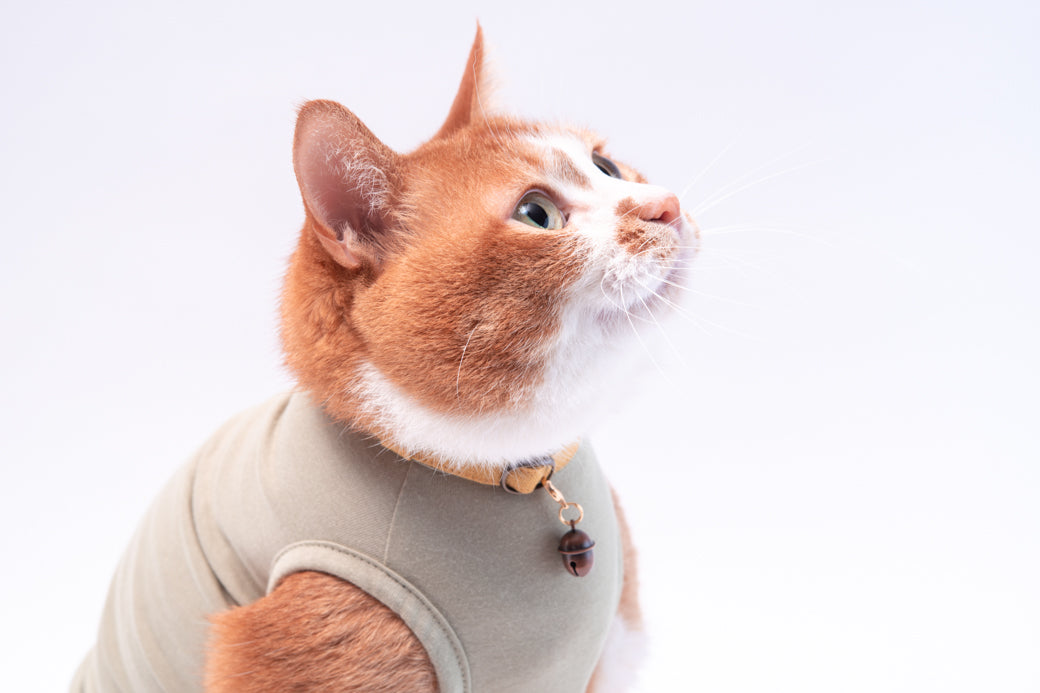
If your cat scratches excessively, they may be fitted with a protective suit or an Elizabethan collar to prevent further injury to the skin.
|
【Related Products】 |
Summary

For people who suffer from hay fever, the upcoming season is very difficult. While hay fever in cats is not very common, it's still hard to watch your cat constantly scratching. We want to take measures so that both humans and cats can live comfortably. Let's take thorough measures and get through this difficult season.

![Feline Infectious Peritonitis (FIP) Treatment Guide [2024 Edition]: Latest Information and Treatment Options](http://www.poponeko.jp/cdn/shop/articles/shutterstock_1633580878.jpg?height=400&v=1727181737)


![[Set] Leaf Ribbon - Sunny Mimosa & Scrunchie Cat Collar - MUJI Belgian Linen - Mustard](http://www.poponeko.jp/cdn/shop/files/2608_00411_b02e5118-d247-450a-94cd-97dbd7e27b54.jpg?v=1790033858&width=600 "[Set] Leaf Ribbon - Sunny Mimosa & Scrunchie Cat Collar - MUJI Belgian Linen - Mustard")
![[Set Product] Leaf Ribbon & Cat Collar - Champs de Fleurs Light Green](http://www.poponeko.jp/cdn/shop/files/DSC00102_e084695b-e8f0-442d-89e1-43de838500c2.jpg?v=1780663183&width=600 "[Set Product] Leaf Ribbon & Cat Collar - Champs de Fleurs Light Green")
![[Set] Leaf Ribbon moda The Fleeting Outdoors & Cat Collar Stain-Resistant Water-Repellent Oil-Repellent Black](http://www.poponeko.jp/cdn/shop/files/260618_00173-2.jpg?v=1784452166&width=600 "[Set] Leaf Ribbon moda The Fleeting Outdoors & Cat Collar Stain-Resistant Water-Repellent Oil-Repellent Black")
![[Set] Leaf Ribbon & Tartan Check Cat Collar (Dress Green)](http://www.poponeko.jp/cdn/shop/files/2606_00017.jpg?v=1785759845&width=600 "[Set] Leaf Ribbon & Tartan Check Cat Collar (Dress Green)")
![[Set] Leaf Ribbon Fleurage Blue & Scrunchie Cat Collar Belgian Linen Mustard](http://www.poponeko.jp/cdn/shop/files/2608_00134.jpg?v=1789197487&width=600 "[Set] Leaf Ribbon Fleurage Blue & Scrunchie Cat Collar Belgian Linen Mustard")
![[Set] Leaf Ribbon moda Star Spangled & Cat Collar Denim Navy](http://www.poponeko.jp/cdn/shop/files/260618_00160.jpg?v=1784451813&width=600 "[Set] Leaf Ribbon moda Star Spangled & Cat Collar Denim Navy")
Leave a comment