
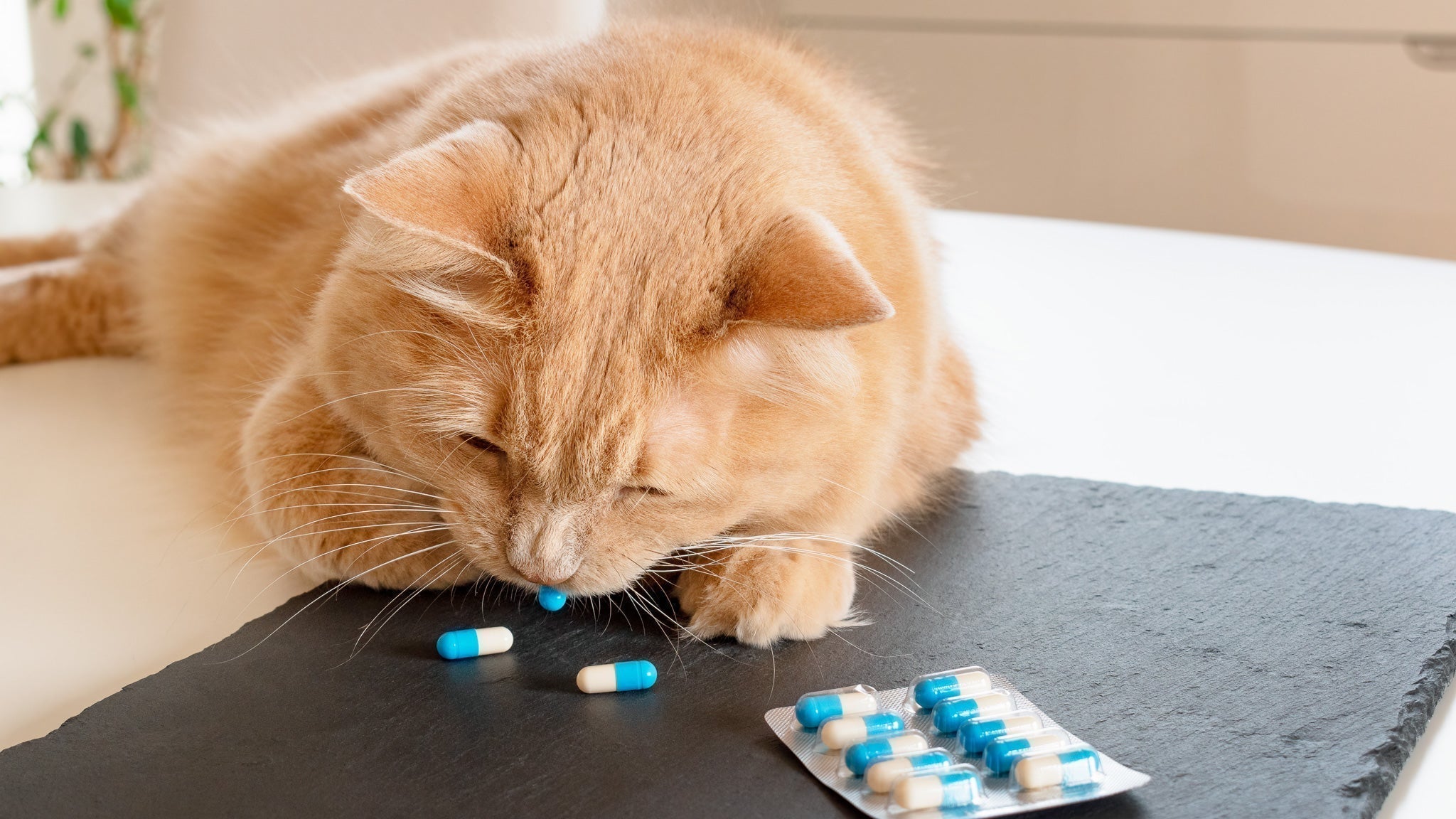
While toys and strings are the most common causes of accidental ingestion in cats, medications can also be accidentally ingested. This article explains accidental ingestion of human medications.
What happens if a cat ingests human medication?

Differences in Drug Metabolism between Cats and Humans
Most drugs and toxins ingested by both humans and cats are metabolized in the liver, detoxified, and excreted from the body. Various metabolic enzymes are involved in detoxification in the liver, but these enzymes differ by animal species, and cats differ from humans. Among the metabolic enzymes in the liver, cats lack the enzymes necessary for a metabolic pathway called "glucuronide conjugation," making them animals with a lower detoxification ability compared to humans.
Why some medications can be life-threatening to cats even in small amounts
Drugs are metabolized and detoxified in the liver, but the specific metabolic enzymes that break down each drug differ. Cats cannot perform glucuronide conjugation, so drugs metabolized by this pathway are not broken down, which can lead to toxic symptoms and even be life-threatening.
In cases of drug ingestion, vomiting may be induced, but cats often do not vomit, and the drug may be absorbed into the body, leading to poisoning.
Symptoms may not appear immediately, so caution is needed
Not all drugs cause symptoms immediately after ingestion. The time it takes for symptoms to appear varies depending on the ingested ingredients, amount, and the cat's constitution. If you notice your cat has ingested something but see no immediate symptoms and decide to wait and see, their condition could worsen.
Commonly ingested medications and their danger levels for cats

Analgesics and antipyretics (e.g., acetaminophen, ibuprofen)
The ingredients in human analgesics and antipyretics are very dangerous for cats.
Acetaminophen is an antipyretic prescribed for coronavirus or influenza infections, but it is extremely dangerous if ingested by cats, causing toxic symptoms even in small amounts. Ingestion of acetaminophen by cats can lead to severe liver damage, anemia, and even death.
Ibuprofen is also commonly used in human analgesics and antipyretics, but it can cause poisoning in cats. It can lead to stomach ulcers and kidney failure.
Aspirin is also dangerous. While used as an analgesic and antipyretic, aspirin is sometimes used as an antithrombotic agent in cats. The dosage for cats is small, and ingesting just one human tablet can cause poisoning. Symptoms include loss of appetite, lethargy, gastrointestinal bleeding, and rapid breathing.
Recently, Loxonin is often prescribed or purchased as a pain reliever, but the safe dosage for cats is very small, so it is rarely prescribed for cats. Ingesting human Loxonin can cause damage to the digestive tract and kidneys.
Antibiotics, sedatives, anticancer drugs, etc.
Various drugs are considered dangerous for cats and are contraindicated. As mentioned above, acetaminophen is also a contraindicated drug. Most of the contraindicated drugs are injectables, so accidental ingestion is unlikely. While many human medications are used in cats, some antibiotics, sedatives, and anticancer drugs can easily cause side effects, requiring changes in medication or adjustment of dosage. Therefore, if a large amount of these drugs is ingested, strong side effects may appear.
Don't be complacent about cold medicine and supplements either
Human cold medicines often contain acetaminophen as an antipyretic and analgesic. If accidentally ingested, or if intentionally given to a cat with a cold, it can lead to acetaminophen poisoning.
Supplements also require caution. Alpha-lipoic acid, found in human diet products, can cause poisoning. Poisoning can lead to severe hypoglycemia and liver dysfunction, which can be life-threatening. The toxic dose is about 13mg per 1kg of the cat's body weight, and depending on the product, a single tablet can be fatal.
"A small amount of human medicine is fine" is a big mistake.
During examinations, we encounter many owners who have used human oral medications or topical medications (ointments, etc.) to monitor their pets. Some even split tablets by comparing the weight of humans and animals. In fact, there have been cases of drug poisoning accidents where owners self-administered divided doses and reported toxic symptoms.
Veterinary hospitals also use human medications, but they calculate and prescribe the appropriate dose. As mentioned earlier, the detoxification mechanism differs between cats and humans, so there are drugs that can cause poisoning even in small amounts. You should absolutely avoid using human medications based on your own judgment.
My cat licked/ingested medicine? What to do immediately

First, calmly check the name, ingredients, and quantity of the medication.
It is important to know "when, what, and how much" was ingested. In the case of human medication, even a small amount can be toxic, so the name, ingredients, and quantity of the medication are crucial. If it's a prescribed medication, the details should be in your medication record book; if you're unsure, contact the prescribing hospital. For over-the-counter medications, the name of the medicine should be on the package. Check it and inform the veterinary hospital.
Contact a vet immediately, even if your cat shows no symptoms
Poisoning does not always appear immediately. Toxic symptoms typically appear after the substance has been absorbed in the stomach or intestines, so it may take some time for symptoms to manifest. Furthermore, the time it takes for symptoms to appear varies depending on the drug's ingredients, quantity, and the cat's constitution. Even if there are no apparent abnormalities, contact a veterinary hospital immediately.
Forcing vomiting or giving water or milk is dangerous
Some medications can cause choking if vomited and aspirated. Additionally, they may be more easily absorbed with food or pushed from the stomach to the small intestine. Therefore, do not force vomiting or give water or milk.
Information to tell the vet (medication name, time, symptoms, etc.)
If drug ingestion is suspected, please state "when, what, and how much" was ingested. This is because the treatment method, whether to induce vomiting or perform gastric lavage, will change. Also, report the current symptoms. In addition to treatment for ingestion, sedation will be necessary if seizures occur, and measures to raise blood sugar will be needed if hypoglycemia occurs.
The condition in which the drug was ingested is also important. Please state whether the cat swallowed only the drug or the drug with its packaging. If only the drug was swallowed, emesis or gastric lavage will be performed, but if the packaging was swallowed, it may be necessary to remove it with an endoscope or gastric incision to prevent damage to the stomach or esophagus.
Things to be aware of before seeing a vet

Wipe off any remaining medicine fragments in the mouth
Cats sometimes chew on ingested medication, and fragments may remain in their mouth. Depending on the type of medication, it can irritate the oral mucosa. If fragments remain, wipe them off. However, since you will be putting your fingers into the cat's mouth, wear gloves, and if the cat bites, do not force removal.
Do not rely on self-diagnosis from the internet.
If your cat ingests medication, you may panic and blindly trust information found on the internet. For example, giving water or making them vomit with salt water. Also, the information about the ingested medication may not be accurate. Following advice found on the internet could potentially worsen the situation. If you do search online, don't take the information at face value; take a deep breath before you research. The best course of action is to contact a veterinary hospital, not the internet.
What is an "emergency pet information notebook" that you should keep at home?
Accidental ingestion can happen at any time. During the day, you can consult your regular vet, but on holidays or at night, you'll need to find an available hospital. To avoid panicking, pick out a few hospitals that can respond in advance and make a note so you can find them easily. It's also a good idea to create a notebook with information to tell the hospital and any medications your cat usually takes.
What you can do to prevent accidental ingestion

Medicine management methods (shelves, cases, handling of leftover medicine)
Most cases of medication ingestion in cats are due to insufficient management by humans. Medication left within a cat's reach, or a storage container dropped and broken, can lead to ingestion. Therefore, it is necessary to never leave medication out, store it in places cats cannot open, such as shelves, and place it in locations where it cannot be easily accessed even if it's in a case. It is also necessary to keep cats out of rooms where medication is present.
Pick it up immediately if dropped / Do not place it within reach of cats
Cats do not recognize medicine as medicine. They are interested in things that roll around. They also put things in their mouths to determine if they are edible. If you drop medicine, always pick it up. Do not put it off until later. Also, cats may drop and eat medicine, so never place it within reach of cats.
Recognize the risks of not only oral medications but also patches and ointments.
Not only oral medications but also patches and ointments contain medicinal ingredients. There have been cases where cats chewed on patch bags or ointment tubes and licked the contents. Don't assume "it's just a patch or an ointment, so it'll be fine"; recognize that these are also medications and always put them away.
Summary

Accidental medication ingestion in cats occurs due to improper medication management by humans. Some medications can cause poisoning even in small amounts. If your cat accidentally ingests medication, contact a veterinarian immediately and seek treatment. It is also crucial to store medication out of your cat's reach.

![Feline Infectious Peritonitis (FIP) Treatment Guide [2024 Edition]: Latest Information and Treatment Options](http://www.poponeko.jp/cdn/shop/articles/shutterstock_1633580878.jpg?height=400&v=1727181737)


![[Set] Leaf Ribbon & Cat Collar - Gingham Check (Raspberry)](http://www.poponeko.jp/cdn/shop/files/DSC00111_50fa7dfb-0b92-465f-96f3-373274a75e62.jpg?v=1780663890&width=600 "[Set] Leaf Ribbon & Cat Collar - Gingham Check (Raspberry)")
![[Set Product] Leaf Ribbon & Cat Collar "Champ de Fleurs" Pink](http://www.poponeko.jp/cdn/shop/files/DSC00100_cf7eae7a-b352-4d9f-ba35-9c34a715038e.jpg?v=1780663183&width=600 "[Set Product] Leaf Ribbon & Cat Collar \"Champ de Fleurs\" Pink")
![[Set Item] Leaf Ribbon & Cat Collar - Tartan Check Royal Red](http://www.poponeko.jp/cdn/shop/files/2606_00014.jpg?v=1785759845&width=600 "[Set Item] Leaf Ribbon & Cat Collar - Tartan Check Royal Red")
![[Set] Leaf Ribbon Fleurage Blue & Scrunchie Cat Collar Belgian Linen Mustard](http://www.poponeko.jp/cdn/shop/files/2608_00134.jpg?v=1789197487&width=600 "[Set] Leaf Ribbon Fleurage Blue & Scrunchie Cat Collar Belgian Linen Mustard")
![[Set] Leaf Ribbon & Cat Collar - Champ de Fleurs (Grey)](http://www.poponeko.jp/cdn/shop/files/DSC00103_d587ccde-94a5-4f05-91f3-f4c88b18ab90.jpg?v=1780663183&width=600 "[Set] Leaf Ribbon & Cat Collar - Champ de Fleurs (Grey)")
![[Set] Leaf Ribbon Moda Fab-Boo-Lous & Cat Collar Cotton Oxford Orchid](http://www.poponeko.jp/cdn/shop/files/260618_00166.jpg?v=1784451812&width=600 "[Set] Leaf Ribbon Moda Fab-Boo-Lous & Cat Collar Cotton Oxford Orchid")

Leave a comment