

In daily practice, a significant number of people visit with skin problems. Among them, it is surprisingly common to see cats suffering from hair loss on their tails or severe itching. It's painful for owners to see their beloved cat repeatedly pulling out tail hair or licking it until it bleeds.
Skin problems caused by cats licking or scratching their skin excessively are called "lick dermatitis" or "scratch dermatitis." The main causes of lick dermatitis and scratch dermatitis on a cat's tail are "dermatitis due to allergies or external parasites," "stress," and "pain." It's important not to leave it untreated and to address it promptly.
Why? 3 Reasons Why Cats Lick and Scratch Their Tails

The three main causes of "lick dermatitis" and "scratch dermatitis" on the tail are:
- Stress and anxiety (environmental changes, boredom, etc.)
- Skin abnormalities (fleas/mites, allergies, bacterial infections)
- Hidden pain (arthritis, injury, neuralgia)
1. Excessive Grooming from Stress or Anxiety
When cats feel anxious or conflicted, they groom themselves to calm down (displacement behavior). Displacement behavior is an action completely unrelated to anxiety relief, and common displacement behaviors in cats include grooming, clawing, and yawning. For example, have you ever seen your cat suddenly start grooming when they failed to climb a cat tree? This is displacement behavior. Usually, it ends at that moment.
However, if minor daily changes such as moving, a new pet, a dirty litter box, or being left alone for a long time become severe stressors, the displacement behavior may become repetitive, reaching a level that interferes with the cat's daily life (stereotypical behavior). This can lead to excessive grooming, resulting in hair loss on the tail or severe dermatitis.
Related Articles

2. Parasites such as Fleas and Mites, Allergic Dermatitis, Atopic Dermatitis
External parasites such as fleas and mites can cause severe itching when they attach to a cat's body. While itching can occur all over the body, the area around the rear and tail is prone to flea infestations and is a common site for flea allergy dermatitis. Flea allergy dermatitis causes severe itching, leading to scratching and licking not only the tail but also the abdomen and back.
In cases of food allergies, eating certain foods can cause itching and lead to scratch dermatitis. It can also cause itching around the anus and diarrhea, leading to persistent licking and lick dermatitis of the rear and tail. Feline atopic dermatitis is an allergic reaction to environmental allergens (such as fleas, mites, pollen, and house dust), causing characteristic skin inflammation and hair loss. Since severe itching occurs, if itching develops on the tail, the cat will lick it excessively.
3. Tail Injuries, Joint Pain, and Neurological Abnormalities
Cats may also lick when they are in pain. They lick to try and alleviate the pain. The tail can be injured in various ways, such as being caught, stepped on, or bumped when falling, causing pain that the cat may continuously lick to try and soothe. This is a case where the problem is "inside" rather than on the skin surface. If the tail has been caught in a door or bruised from a fall, the cat may continue to lick it to alleviate joint pain or discomfort.
One cause of lick dermatitis in cats can also be feline hyperesthesia syndrome (FHS). FHS is a condition where various symptoms appear, such as the back twitching, suddenly running, or violently chasing and biting the tail. The causes are diverse, including neurological, orthopedic, psychological factors, and external parasites, and FHS is diagnosed by excluding these conditions. Treatment often involves alleviating stress, incorporating more play, and changing the owner's interaction methods, but improvement can take time.
What are the Dangers of Leaving Excessive Tail Grooming Untreated?

Worsening from Hair Loss to Bleeding and Pus (Secondary Infection)
A cat's tongue is rough, so continuous licking can easily abrade the skin. In some cases, cats may lick so much that even the muscle beneath the skin becomes visible.
Beyond hair loss, the skin can break open and bleed, allowing bacteria to enter and cause pus (secondary infection). In severe cases, this can lead to sepsis and be life-threatening. For the tail, biting can cause tissue necrosis, sometimes necessitating an amputation (tail removal surgery).
Transitioning to "Compulsive Disorder" where Licking Becomes a Habit
Compulsive disorder is a condition where an animal repeatedly performs a certain action, to the point where it interferes with daily life. While often caused by stress, repeated licking of the skin can lead to "licking becoming a habit," making it an unstoppable condition. Compulsive disorder is essentially a mental illness. If it progresses to compulsive disorder, the cat will continue to lick even if the skin is in a very severe state. It is necessary to start treatment early, before it reaches this point.
What to Do if You Notice Your Cat Scratching Its Tail Excessively? Steps Owners Should Take

First, Protect the Affected Area and Physically Prevent Licking
Scolding with "No!" is counterproductive. It may cause further stress to the cat, potentially worsening the licking and scratching.
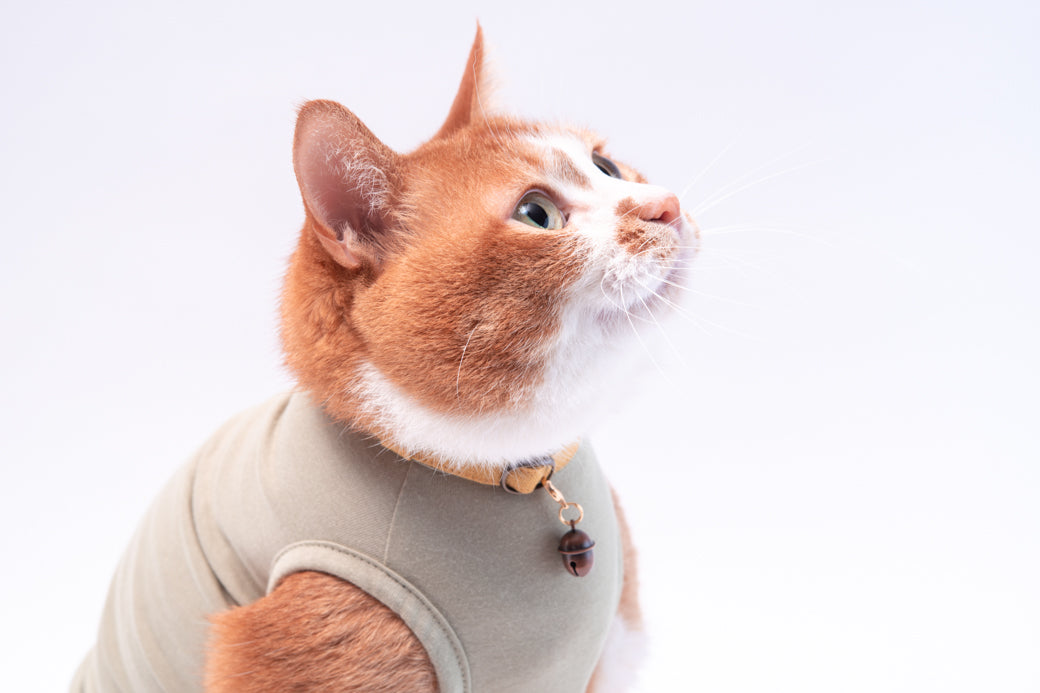
First, as an emergency measure to prevent further deterioration, it is necessary to use an Elizabethan collar or skin protective clothing to physically prevent the cat's mouth or paws from reaching the tail. Soft collars made of flexible material may still allow the cat to reach its tail. Additionally, with hard Elizabethan collars, the edge of the collar might injure the tail, so measures like covering the edge of the collar with a soft material are necessary. Skin protective clothing may not cover the entire tail, but if the tail cannot be bitten, the cat might lick or bite other parts of its body. It is advisable to protect the tail with bandages and then put on skin protective clothing.
Do Not Self-Diagnose the Cause; Visit a Veterinarian Immediately
The causes of licking and scratching are varied, and the problem will not be resolved without identifying and treating the underlying cause. Whether antipruritics, antibiotics, or mental stability care are needed, veterinarians will identify the cause comprehensively, not only through skin examinations, imaging tests, and blood tests, but also by considering the cat's personality, living environment, and preventive care history. Therefore, owners should refrain from self-diagnosis.
Checkpoints to tell your veterinarian during the visit:
- How long has the cat been licking/scratching, and how often?
- Does the cat stop when spoken to?
- Is there a specific time when the cat licks (after eating, while alone, etc.)?
- Is the cat on flea and tick prevention?

![Feline Infectious Peritonitis (FIP) Treatment Guide [2024 Edition]: Latest Information and Treatment Options](http://www.poponeko.jp/cdn/shop/articles/shutterstock_1633580878.jpg?height=400&v=1727181737)


![[Set] Leaf Ribbon & Scrunchie Cat Collar, Gingham Check, Yellow](http://www.poponeko.jp/cdn/shop/files/DSC00094_3cfceafb-3dec-4966-8fb0-98d2b6a0f857.jpg?v=1780663891&width=600 "[Set] Leaf Ribbon & Scrunchie Cat Collar, Gingham Check, Yellow")
![[Set] Leaf Ribbon & Cat Collar: Petit Fleur, Blue](http://www.poponeko.jp/cdn/shop/files/2608_00407.jpg?v=1789946167&width=600 "[Set] Leaf Ribbon & Cat Collar: Petit Fleur, Blue")
![[Set] Leaf Ribbon & Scrunchie Cat Collar, Tartan Check, Royal Red](http://www.poponeko.jp/cdn/shop/files/2606_00006.jpg?v=1785759845&width=600 "[Set] Leaf Ribbon & Scrunchie Cat Collar, Tartan Check, Royal Red")
![[Set Product] Leaf Ribbon & Scrunchie Cat Collar - Champ de Fleurs - Mustard](http://www.poponeko.jp/cdn/shop/files/DSC00090_e7a82019-68d6-4981-b52a-6e8c333c0f32.jpg?v=1780663183&width=600 "[Set Product] Leaf Ribbon & Scrunchie Cat Collar - Champ de Fleurs - Mustard")
![[Set] Leaf Ribbon moda Lydia Lace & Cat Collar Ayakasuri Akane](http://www.poponeko.jp/cdn/shop/files/260618_00159.jpg?v=1784451813&width=600 "[Set] Leaf Ribbon moda Lydia Lace & Cat Collar Ayakasuri Akane")

Leave a comment