

When you think of "big cats," the Norwegian Forest Cat comes to mind. Along with the Maine Coon, they are a popular large breed of cat.
While they are very gentle and social cats, many owners worry about whether cat collars or harnesses will fit them properly due to their size.
It’s interesting to wonder just how big they actually get. So, in this article, we would like to focus on their "size," including the weight, body length, and growth process of the Norwegian Forest Cat.
The Size of the Norwegian Forest Cat

The Norwegian Forest Cat has a big-boned, muscular, and sturdy body that gives it a wild flair. They are known as very large cats, but just how big are they really?
A Sturdy, Large Build
Cat body types are generally categorized into six groups based on size and physique.
The Norwegian Forest Cat falls into the largest and most substantial category: "Long and Substantial." Maine Coons and Bengals are also of the Long and Substantial type.
【Cat Body Types】
- Oriental (Siamese, Cornish Rex, etc.)
- Foreign (Abyssinian, Russian Blue, etc.)
- Semi-Foreign (Munchkin, American Curl, Ocicat, etc.)
- Semi-Cobby (American Shorthair, Scottish Fold, etc.)
- Cobby (Exotic, Persian, etc.)
- Long and Substantial (Norwegian Forest Cat, Maine Coon, etc.)
|
【Related Articles】 |
Average Weight of the Norwegian Forest Cat
The average weight for an adult Norwegian Forest Cat is about 3.5–5.5 kg for females and 3.5–6.5 kg for males. Males tend to grow larger than females, and some can even exceed 10 kg.
The average weight of a typical cat is about 3–5 kg. When you compare an ordinary cat to a Norwegian Forest Cat, which can be 1.5 to 2 times larger, their size is quite evident.
Body Length of the Norwegian Forest Cat
The body length (from chest to rump) of the Norwegian Forest Cat is about 30–45 cm. Since the average body length of a cat is about 25–30 cm, there might be a size difference of more than two notches when compared side-by-side.
European Line and American Line
There are two bloodlines of Norwegian Forest Cats: the "European line" and the "American line."
The European line features a wild-looking face, a robust and large skeleton, and a long tail. The American line has a gentler face, a slightly shorter torso, and a more delicate appearance.
It is said that most Norwegian Forest Cats living in Japan are of the American line.
Growth Process of the Norwegian Forest Cat

Norwegian Forest Cats grow to be about twice the weight of a typical cat, but are they also big as kittens?
We have also summarized the growth process of the Norwegian Forest Cat.
Takes 3 to 5 Years to Become an Adult
A typical cat reaches adulthood in about one year. However, it is said that it takes 3 to 5 years for a Norwegian Forest Cat to fully mature. Some continue to grow even after passing the age of five.
The Norwegian Forest Cat is a slow-growing breed. Many cats are spayed or neutered around 6 months of age, but please consult your veterinarian carefully regarding the timing for these surgeries.
Weight Progression of the Norwegian Forest Cat
Like other cats, the Norwegian Forest Cat grows rapidly until about one year of age.
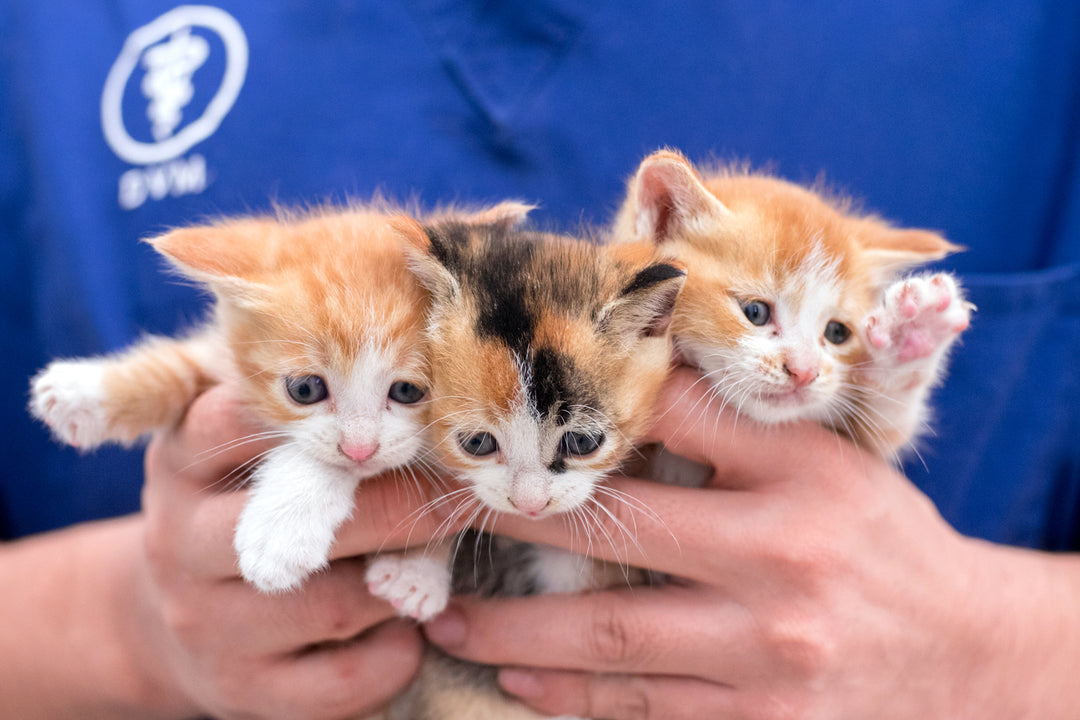
They weigh about 100g at birth—about the same as a typical cat—though some can be born weighing 150g to 200g.
According to the "Japan and World Cat Catalog 2019 Edition," their weight increases to 500g at one month, 1,700g at three months, and 3,000–5,500g at six months. By six months, they have already exceeded the average weight of a typical adult cat.
Short Hair for the First Year
While the Norwegian Forest Cat has a fluffy coat, they are actually "short-haired" as kittens.
After six months to a year, their fur begins to grow all over their body. This process of the coat growing in as they mature is called "blooming," a unique characteristic of the Norwegian Forest Cat.
They attain their gorgeous look when they reach adulthood, and their fur continues to grow over the course of 3 to 5 years. Brushing is essential to maintain the beauty of their coat. During the shedding season in particular, the dense undercoat will fall out in clumps, so you need to be careful about hairballs and trichobezoars.
Why the Norwegian Forest Cat Is So Large

The origin of the Norwegian Forest Cat is believed to date back to the 8th–10th century when Vikings brought long-haired cats from Turkey.
The Scandinavian Peninsula, where Norway is located, has a harsh, cold environment. It is likely that the Norwegian Forest Cat, with its large size and high hunting ability, emerged to survive in such a land.
Their gorgeous coat is a "double coat," a two-layered structure consisting of water- and oil-repellent outer hairs and a dense undercoat that protects them from the cold. Because of this thick coat, they appear even larger than their actual physical build.
Excellent Athleticism Despite Their Size
As the name suggests, the Norwegian Forest Cat is a breed that has survived by hunting in the forests of Norway.
Despite their large bodies, they have excellent athletic ability and are also good at climbing trees. Even if kept strictly indoors, make sure to provide them with cat trees or cat steps so they have a place to overlook their surroundings.
However, since they are heavy cats, try to choose ones that are sturdy and stable. You should also take measures to prevent furniture from tipping over.
Small Meows Despite Their Size
The Norwegian Forest Cat has a small voice. They are characterized by short, high-pitched chirps and trills like "kyururu" or "kururu." They tend to meow most often when they want to be pampered by their owners.
When they chirp so cutely despite their large size, you might find yourself saying "yes" to whatever they are begging for.
Summary

The size of a Norwegian Forest Cat varies by individual and also changes depending on the environment and diet in which they are raised.
The average weight of an adult Norwegian Forest Cat is about 3.5–5.5 kg for females and 3.5–6.5 kg for males. Larger individuals can exceed 10 kg. Be sure to choose litter boxes, beds, carriers, and cages that fit their size.
Popo-Neko’s cat collars come in L size (suitable neck circumference 17–23 cm), and our cat harnesses are also available in L size (waist circumference up to about 46–50 cm), so please measure your cat before purchasing.
The Norwegian Forest Cat is a large cat that grows slowly over 3 to 5 years. Pay attention to their exercise and food intake, and provide an environment where they can play in a way that suits their breed.
|
【Related Articles】 |
Author Profile







Leave a comment