
Have you ever heard of a cat's "anal glands"?
Perhaps some owners are worried, thinking, "I heard a foul-smelling liquid came out of my cat's rear, and if I don't express the anal glands, they might burst..."
To answer such questions, this time we would like to explain in an easy-to-understand way how to care for and express your cat's anal glands.
What are a cat's anal glands?

A cat's anal glands are sac-like structures, one on each side of the anus, officially called the "anal sacs."
The secretions from the anal glands accumulate in these sacs, and they smell... unpleasant.
This strongly scented secretion is called "anal gland fluid" or "anal sac fluid," and cats use it for scent marking. When cats sniff each other's rear ends, it's because they are exchanging information through the scent of their anal glands.
The consistency of the anal gland fluid varies greatly from cat to cat; some have thick, pasty fluid, while others have thin, liquid fluid. The color also varies, ranging from brown to yellow or gray.
Anal gland fluid and anal sac fluid are discharged with feces. They can also squirt out when a cat is stressed or surprised.
If you notice a foul smell after your cat is startled by a loud noise and jumps, it might be due to their anal glands.
Anal Gland Diseases in Cats

You might see "anal gland expression" on the menu at dog grooming salons. Do cats need anal gland expression too?
Hearing "anal glands might burst" can be frightening. First, let's learn about anal gland diseases in cats.
"Anal Sacculitis," an anal gland disease in cats
Anal gland fluid and anal sac fluid are normally discharged naturally with feces.
However, in cats who lack exercise or sufficient water intake, kittens, or senior cats with decreased muscle strength, the secretions may not be expelled properly and tend to accumulate.
If the anal glands become clogged or infected with bacteria, the anal sacs can become inflamed. Symptoms such as pus accumulation, redness, swelling, and enlargement of the anus are called "anal sacculitis."
"Anal Gland Rupture," an anal gland disease in cats
If the anal glands become blocked and too much fluid accumulates, they can rupture. The skin near the anus tears open, and pus emerges. If your cat's rear end is wet and smells foul, an anal gland rupture may be suspected.
Treatment for Anal Sacculitis and Anal Gland Rupture
First, the anal glands are gently compressed to express the accumulated secretions. If the anal glands are blocked, a catheter may be inserted to flush them with saline. Most cats recover with antibiotic treatment.
If an anal gland has ruptured, surgical repair is required. Furthermore, if anal sacculitis or anal gland rupture recurs frequently, surgical removal of the anal glands may be recommended.
Watch out if your cat is "scooting"!

Have you ever seen your cat scooting on their bottom, dragging their rear end across the floor with their legs stretched up?
While your cat's "scooting" or commonly known as "cat tank" might look cute, it could actually be a sign that their anal glands are full and causing discomfort.
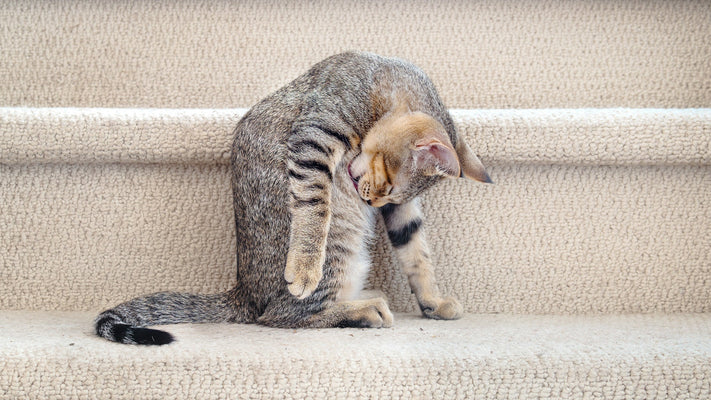
Also, if your cat is frequently bothered by or licking their rear end, it is highly likely that their anal glands are full.
If you notice your cat frequently scooting or doing the "cat tank," bothering or licking their rear end, avoiding sitting, getting angry when their rear end is touched, or a foul odor coming from their rear, take them to the vet immediately.
How to express a cat's anal glands and how often

Cats whose anal glands tend to accumulate fluid should have them expressed regularly. However, it is very difficult for owners to express their beloved cat's anal glands themselves.
It's possible to injure the anal glands, so be sure to ask your veterinarian how to express them, or have it done at a veterinary clinic.
How to express a cat's anal glands
A cat's anal glands are located at the 4 and 8 o'clock positions below the anus. Place your fingers there and squeeze upwards to express them.
Be careful as the fluid can come out forcefully or splatter. It's recommended to do it in the bathroom or while holding a tissue. If your cat struggles, never force it.
Guidelines and frequency for cat anal gland expression
Cats who have had anal sacculitis or anal gland rupture in the past should have their anal glands expressed every 1 to 2 months. The guidelines for anal expression are whether the cat is scooting or showing signs of being bothered by their rear end. If you notice any abnormalities, seek veterinary attention immediately.

Summary

A cat's anal glands accumulate foul-smelling secretions, and if not naturally expressed, this can lead to "anal sacculitis" or "anal gland rupture."
While not widely known, anal gland diseases in cats also require attention.
Cats whose anal glands tend to accumulate fluid require regular expression, but this can be quite difficult. It's a delicate area for cats, and it requires skill. We recommend entrusting this task to a veterinarian rather than attempting it at home.
A cat's scooting might be a sign of an anal gland abnormality. Always keep your cat's perianal area clean and periodically check for inflammation or swelling around the anus.

Author Profile


![[Written by a Veterinarian] Is excessive paw grooming in cats a sign to trim their nails? Stress-free care methods](http://www.poponeko.jp/cdn/shop/articles/shutterstock_2431101915_ffb64d55-478e-40f0-a31b-29b648867e1e.jpg?height=400&v=1784983750)

![[Set Product] Leaf Ribbon & Cat Collar - Gingham Check Green](http://www.poponeko.jp/cdn/shop/files/DSC00113_9928b03b-5bce-4bf5-b54f-3a4ef263fb16.jpg?v=1780663891&width=600 "[Set Product] Leaf Ribbon & Cat Collar - Gingham Check Green")
![[Set] Leaf Ribbon & Scrunchie Cat Collar - Vidro (Aster)](http://www.poponeko.jp/cdn/shop/files/2608_00415.jpg?v=1789826564&width=600 "[Set] Leaf Ribbon & Scrunchie Cat Collar - Vidro (Aster)")
![[Set] Leaf Ribbon & Cat Collar Gingham Check Blue](http://www.poponeko.jp/cdn/shop/files/DSC00106_035b8e99-fd67-47ef-9132-ff2da1afbc67.jpg?v=1780663891&width=600 "[Set] Leaf Ribbon & Cat Collar Gingham Check Blue")
![[Set Product] Leaf Ribbon Moda Floribunda & Cat Collar Cotton Ox Carrot](http://www.poponeko.jp/cdn/shop/files/260618_00157.jpg?v=1784451813&width=600 "[Set Product] Leaf Ribbon Moda Floribunda & Cat Collar Cotton Ox Carrot")
Leave a comment