
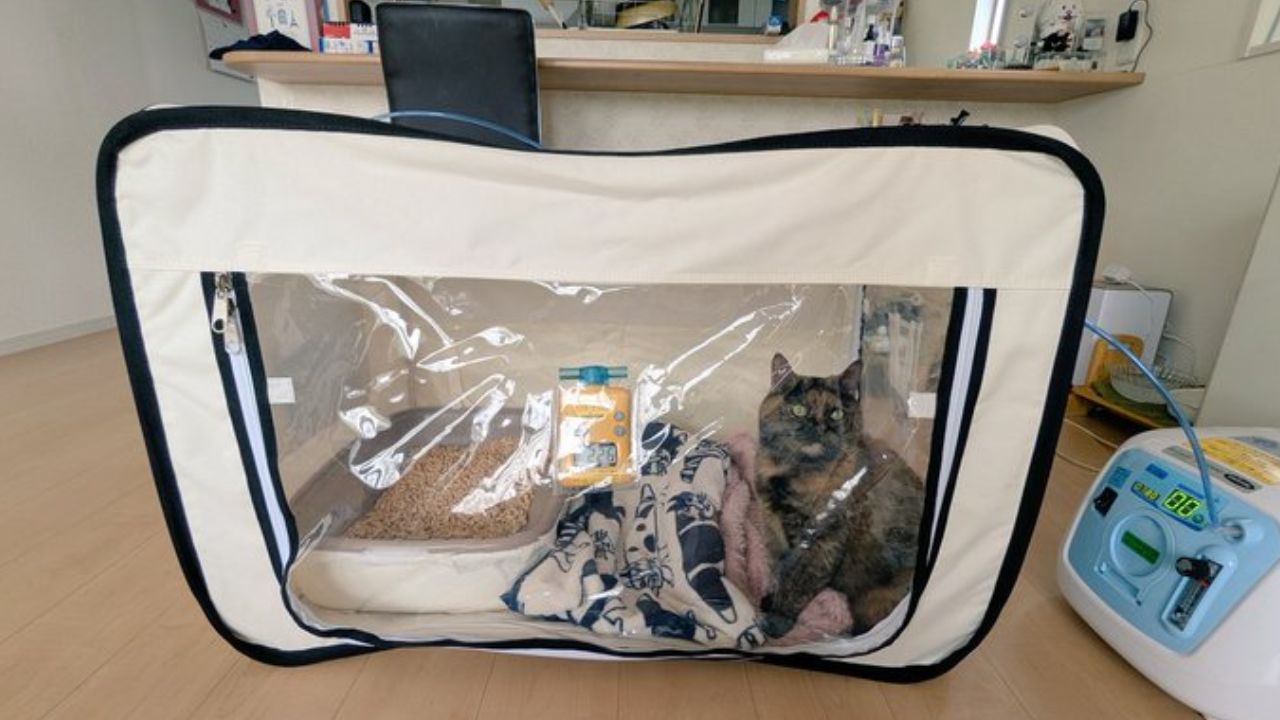
My beloved cat, Gigi, was diagnosed with angiosarcoma, a malignant tumor, at the end of December 2024 and underwent surgery. After the operation, he visited the vet once a month and continued to have good days, but during Golden Week in 2025, a rare cough became a concern, so we went to our regular vet.
I was told that fluid had accumulated in his chest and that it was highly likely the angiosarcoma had metastasized. That was when I started thinking about palliative care to minimize my beloved cat's suffering.
Angiosarcoma metastasized 4.5 months after surgery
According to the veterinarian, Gigi's angiosarcoma had metastasized, so chemotherapy was unlikely to be effective. Since no tumor-like mass was visible on the ultrasound, I was told that "it's highly likely that even if we went to a university hospital, they wouldn't find a tumor and would say the cause is unknown."

Of course, there was the option of doing detailed examinations like a CT scan, clinging to the slight hope that it wasn't angiosarcoma. However, the university hospital was far away, and traveling there would be a burden for Gigi, who was already having difficulty breathing.
While some CT scans can be done without anesthesia for calm cats, accurate results usually require anesthesia. I strongly felt this when Gigi's angiosarcoma was being investigated before, so now there's also the problem of whether Gigi can withstand anesthesia.
And what's burned into my mind is Gigi's reaction after a needle biopsy at the university hospital. He became temporarily like a different cat, fearing humans and growling. It must have hurt him terribly...

Considering all these factors, I worried whether aggressive treatment or pursuing the cause would truly make Gigi happy, and in the end, I chose palliative care.
Renting a UNICOM oxygen chamber as part of palliative care
Even now, I still have doubts about the choice I made. When I see him struggling to breathe, I sometimes think, "Maybe I should have had him examined more thoroughly..." but then I hesitate, thinking, "What if he dies while traveling or at the hospital...?"

I realized that a beloved cat's battle with illness is a continuous series of days where you don't know what the right answer is.
Amidst all that, the one thing I definitely wanted to do was rent an animal oxygen chamber. In my case, I considered three manufacturers, including one recommended by the vet hospital. However, due to the financial issue of spending 5,000 yen per treatment for draining pleural fluid once or twice a week, I decided to rent a cost-effective oxygen chamber from UNICOM.
Unicom's service is divine. I ordered on a Sunday around 2 PM, and it arrived the next day around 11 AM. With Unicom, you rent the oxygen concentrator, and purchase the oxygen cage that serves as the oxygen chamber.

Since I only had an all-mesh enclosure until now, I was grateful that the oxygen cage was a purchase. As I have multiple cats, it's a financial relief to only have to rent the oxygen concentrator if another cat needs an oxygen chamber in the future.
In Unicom's case, you have to set up the oxygen room yourself. However, the instruction manual, which explains how to set it up and use it, was included with the product, and there were also videos available, making it easy to understand.
The oxygen concentrator I rented is the "Oxygen Concentrator Oxyland Z-3000" for short-term to long-term, 24-hour continuous use. It's compact like a rice cooker, but it's quite heavy, so be careful when moving it.
The rental fee for the first month is 19,500 yen, which includes the basic contract fee (round-trip shipping included) and the rental fee. From the second month onwards, the rental fee is 10,000 yen.
You can also rent the "Oxygen Concentration Meter ox-plus" to measure the concentration inside the oxygen chamber. This is definitely something you should have.

If rented simultaneously with the oxygen concentrator, the rental fee for the first month is 1,000 yen for the basic contract fee + 3,000 yen for the rental fee = 4,000 yen. From the second month onwards, the rental fee is 3,000 yen.
The oxygen cage is a "Pet Oxy Hotel Square" M size (9,900 yen). I bought a larger one hoping he could spend time in it more spaciously.
How did my cats react to the pet oxygen chamber?
When I actually set it up, Leon (a brown tabby), who loves new things, immediately showed interest and went inside. No, no. That's not your base.

The oxygen cage comes with two types of lid for the ceiling: a "vinyl type" and a "mesh type." When using it as an oxygen chamber, you attach the vinyl type.
The instruction manual stated to leave the ceiling part about halfway open when using the M-sized oxygen chamber. Additionally, the cage has a hole for inserting the oxygen tube.

Not only the blue tube, but also a dedicated tube that could be inserted into the cage was included.

Gigi had once dislocated his joint by falling from a cat walk when I wasn't looking, so perhaps because it was habitual for him to be put in an enclosure at bedtime when he couldn't be watched, he entered the oxygen chamber without resistance.
Inside the oxygen chamber, he drinks water, eats food, and seems comfortable, even sleeping with his paws inexplicably crossed as usual. His breathing has become slightly less labored, and there's a sparkle in his eyes.
酸素室、届いた!!
— ゆあ | ライター🖊 (@yunc24291) May 12, 2025
ユニコムさん、迅速な対応ありがとう。
朝から、もう呼吸がしんどそうやったので本当に助かった。
ご飯も食べて、お水も飲んでくれてる。
呼吸が苦しいとしんどいの、自分も経験して知ってる分、少しでも楽にしてあげたいと思う。… pic.twitter.com/1y2mThJpf7
However, what surprised me was that there was a time when he managed to escape the oxygen chamber on his own. I put Gigi in the oxygen chamber and went to take a bath, and after my bath, Gigi was at my feet, saying, "Hi!" I was shocked, "Oh, Gigi!!... Huh?? Gigi!? How did you get out!?"
He probably came out through the ceiling that I had left half-open, but I was very surprised because Gigi, who used to sleep in an enclosure, had never been able to escape even when I forgot to close the ceiling.
So, I felt that for active cats, it's important to find ways to prevent escapes, such as by opening the front or side zippers.

Also, for cats that are very wary or experience significant stress when entering a cage or enclosure, it might be a good idea to create an oxygen chamber using their favorite hiding places, a kotatsu, or a storage box, to minimize their stress as much as possible.
Testing the pet oxygen chamber by entering it myself
Seeing Gigi relaxed in the oxygen chamber warms my heart. However, it's common for cat owners to wonder, "How comfortable is it really?" and "I want to make it as comfortable as possible."
I myself have congenital heart disease and my oxygen saturation is about 93%, so I'm used to feeling breathless. That's why I wondered what it was like inside the oxygen chamber, so I actually went inside myself to test its comfort.

(※Since this is an oxygen chamber for animals, please do not imitate me.)
When I actually went inside, it was surprisingly hot. There are places to put ice packs inside the oxygen chamber, but I felt it was important to use air conditioning on hot days to prevent the inside from getting too hot.

Also, although there are differences between humans and animals, I thought it might be painful if there was no escape for the carbon dioxide I exhale. That's probably why the instruction manual states to open the ceiling part halfway, but in my home, just in case, we adjust it so that the oxygen concentration remains around 30-35 by opening the ceiling part halfway and slightly opening the zippers on the front and sides.
By the way, the oxygen concentration of 30-35 was a figure I learned from the veterinarian. I think this is likely a value that takes Gigi's condition into consideration, so please confirm the set value with your regular vet when you actually use it.
However, according to the veterinarian, if the oxygen concentration exceeds 40, the difference in oxygen between being inside and outside the chamber becomes too drastic, which can put a strain on the body. Adjusting the values is important.
Having an oxygen chamber also changes the owner's peace of mind. During palliative care for a beloved cat, you inevitably become tense, with your body constantly on edge.

When I'm taking a bath or cooking, and I inevitably have to take my eyes off him, I get scared that something might happen and rush to him, thinking, "I have to go to him quickly!"
But with an oxygen chamber, I can think, "When I have to leave him, it's time for him to relax in the oxygen chamber. I'll finish what I need to do, and then give him lots of love." This helps the owner to take care of their own mind and body.
Palliative care is also a test of stamina, so I want owners to take care of their own bodies. Because your beloved cat depends on you, if you don't mind me saying so.
Improving your cat's quality of life by effectively using a pet oxygen chamber
However, even for Gigi, who is used to life in an enclosure, spending all his time in the oxygen chamber is still stressful. Even in an M-sized oxygen chamber, it gets cramped if you put a cat litter box in it, and just like humans, cats must also want to "go to their favorite place until the very end" and "do what they like."
What Gigi particularly loves is lounging around with just me. So, in our home, when his breathing becomes labored, he spends some time in the oxygen chamber, and afterward, we spend as much time as possible together, relaxing. This is how we use the oxygen chamber.

Even when his breathing is labored, if I take him out of the oxygen chamber, Gigi goes to the door and signals, "Let's lounge around together upstairs." Seeing him like that makes me contemplate the depth and meaning of palliative care.
Physical care is, of course, important. But mental care is equally important. I want to accumulate "see you tomorrow" as many times as possible, knowing that I don't know how much longer I'll be able to say it.
I hope Gigi feels a little happiness in this daily life where I continue to tell him, "I love you" and "Thank you for being born."




![[Summer Tradition] Seeking advice on how to mentally care for a cat who is a "dragger" and traumatized by fireworks](http://www.poponeko.jp/cdn/shop/articles/009_5a9d1394-584d-4d39-b787-f368a4b014d2.jpg?height=400&v=1727936570)

![[Set] Leaf Ribbon & Cat Collar - Gingham Check Yellow](http://www.poponeko.jp/cdn/shop/files/DSC00108_0dcb125b-7ca2-4c51-a9c7-a1544ae1f9c9.jpg?v=1780663891&width=600 "[Set] Leaf Ribbon & Cat Collar - Gingham Check Yellow")
![[Set] Leaf Ribbon & Cat Collar - Gingham Check Pale Lavender](http://www.poponeko.jp/cdn/shop/files/DSC00112_63ffeab6-aadb-4f1e-87d0-1061074971ac.jpg?v=1780663891&width=600 "[Set] Leaf Ribbon & Cat Collar - Gingham Check Pale Lavender")
![[Set Item] Leaf Ribbon & Cat Collar: Vidro - Akane](http://www.poponeko.jp/cdn/shop/files/2608_00401.jpg?v=1789826564&width=600 "[Set Item] Leaf Ribbon & Cat Collar: Vidro - Akane")

![[Set] Leaf Ribbon moda Lydia Lace & Cat Collar Ayakasuri Akane](http://www.poponeko.jp/cdn/shop/files/260618_00159.jpg?v=1784451813&width=600 "[Set] Leaf Ribbon moda Lydia Lace & Cat Collar Ayakasuri Akane")
![[Set Product] Leaf Ribbon & Scrunchie Cat Collar - Tartan Check Black Watch](http://www.poponeko.jp/cdn/shop/files/2606_00011.jpg?v=1785759845&width=600 "[Set Product] Leaf Ribbon & Scrunchie Cat Collar - Tartan Check Black Watch")
Leave a comment