

When your cat isn't eating their food, most owners have probably tried topping it with wet food or treats.
Wet food has a stronger smell than dry food, so many cats will likely enjoy it more. While delicious, wet food also has the downsides of being smaller in quantity and less cost-effective. Furthermore, giving too much can lead to obesity or encourage picky eating.
This time, we will explain about cat food.
First, understand your cat's body shape.
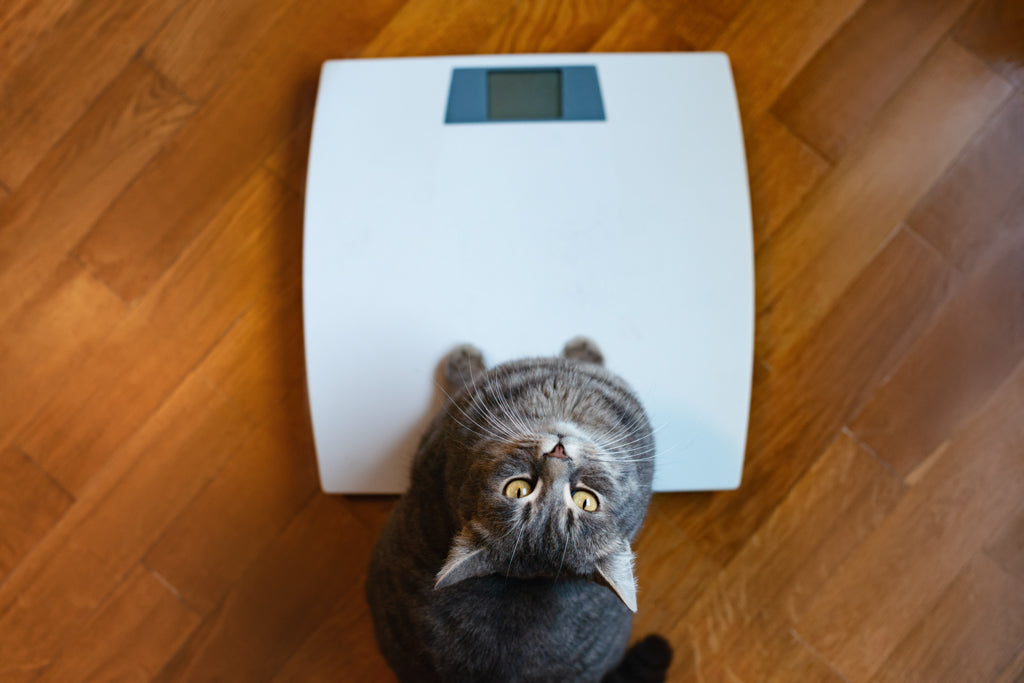
Most pet cats are overweight.
To calculate food calories, you first need to know your cat's body shape. A cat's body condition is assessed using a 5-point scale called the Body Condition Score (BCS). BCS 3 is considered ideal, BCS 1-2 is underweight, and BCS 4-5 is overweight. BCS is evaluated based on the ribs, waist tuck, and abdominal fat pad.
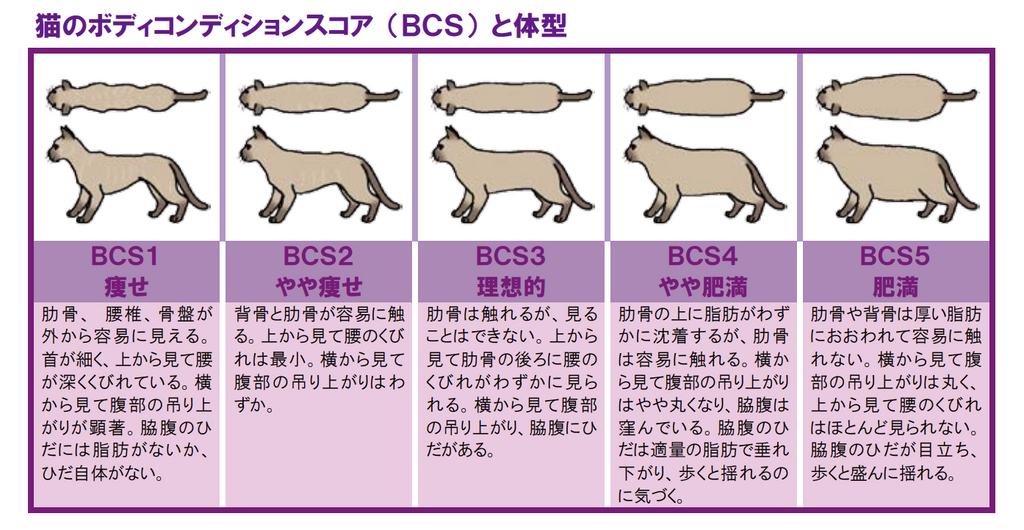
| Reference: Ministry of the Environment "Pet Food Guidelines" |
BCS1 (Underweight)
The cat is extremely thin and emaciated, with ribs and other bones protruding. When viewed from the side, the abdomen is significantly tucked up, and there is almost no fat.
BCS2 (Slightly Underweight)
The cat is underweight, but has slightly more fat than a BCS1. The spine and ribs are easily palpable. When viewed from above, the waist tuck is clearly visible, and when viewed from the side, there is a slight abdominal tuck.
BCS3 (Ideal)
This is the ideal, standard body shape. The ribs are palpable but not visibly protruding. When viewed from above, a slight waist tuck is visible. When viewed from the side, an abdominal tuck can be seen, but the body shape is slightly more rounded than a BCS2.
BCS4 (Slightly Overweight)
This is a slightly overweight body shape. There is a small amount of fat over the ribs, but the ribs themselves can still be felt. When viewed from the side, the abdominal tuck is slightly more rounded, and the abdomen sags with a moderate amount of fat, swaying when the cat walks.
BCS5 (Obese)
This is an obese body shape, where the ribs and spine are covered by thick fat and cannot be felt. When viewed from above, there is almost no waist tuck. The abdominal fat also sags, and it wobbles when the cat walks.
How to calculate the necessary calories for cats
There are several ways to calculate a cat's daily energy requirement (DER), but the most commonly used method is to multiply the resting energy requirement (RER) by a coefficient.
Resting Energy Requirement (RER)
This is the amount of energy an animal needs when at rest. RER is calculated using the following formula:
RER (kcal) = 70 × (body weight (kg))0.75 *raised to the power of 0.75
There is a simpler version of this formula:
RER (kcal) = Body weight (kg) × 30 + 70
The values derived from the two formulas differ slightly, but not significantly.
Daily Energy Requirement (DER)
DER is calculated by multiplying RER by a coefficient. The coefficient varies depending on the cat's condition.
Daily Energy Requirement (DER) = Resting Energy Requirement (RER) × Coefficient
The main DERs are as follows:
- Growing cats (up to 1 year old) RER x 2.5
- Neutered/Spayed cats RER x 1.2–1.4
- Active adult cats RER x 1.6
- Adult cats needing weight loss RER x 0.8
- Senior cats RER x 1.1–1.4
- Resting, critically ill RER x 1.0
Food sold in Japan has recommended feeding amounts listed on the package according to weight. These feeding amounts are merely guidelines. Please adjust the amount while observing your cat's weight gain, activity level, and stool condition.
What is the optimal ratio of dry food to wet food for cats?
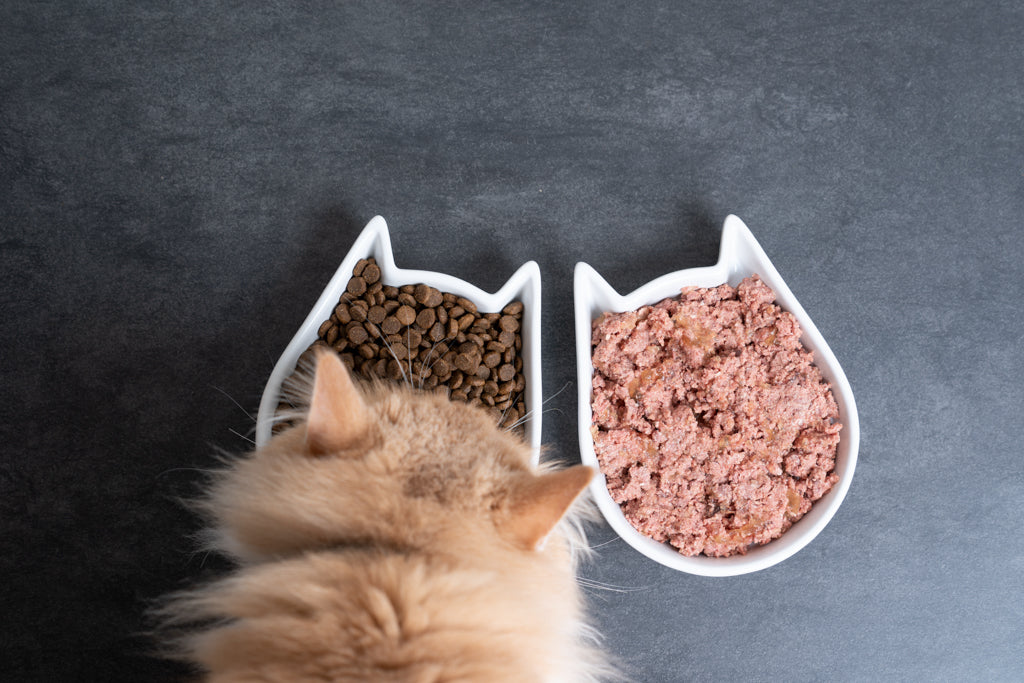
There are no specific rules for the ratio when mixing foods. Care must be taken to avoid overfeeding and exceeding calorie limits when mixing in wet food. Wet food and dry food have different calorie counts per 100g. Calculate the ratio and calorie count you are giving and aim to provide an appropriate amount.
The mixing ratio can also be adjusted based on your cat's health, body type, illnesses, and your lifestyle as the owner.
More wet food
Wet food has a higher moisture content and is used in the treatment of cats with urolithiasis, cystitis, and kidney disease. By increasing the proportion of wet food, in addition to dry food, cats can get the necessary hydration for their bodies.
Also, for overweight cats, increasing the amount of wet food can increase the volume of their meals, making them feel fuller more easily.
More dry food
Wet food is more expensive than dry food, so it is not as cost-effective. Also, for owners who are out for long periods, there is concern about food spoilage. In such cases, it is best to use more dry food and only a small amount of wet food for flavoring.
If you're unsure, consult your veterinarian.
If you are unsure about your cat's body condition or ideal weight, please consult your veterinarian. Veterinarians evaluate body condition on a 9-point scale and calculate the appropriate weight.
Additionally, if a manufacturer sells therapeutic diets, they often have calculation tools for dry and wet food feeding amounts, allowing you to quickly determine the appropriate amount. We recommend having your cat's weight checked at the vet at least once a year.
Summary
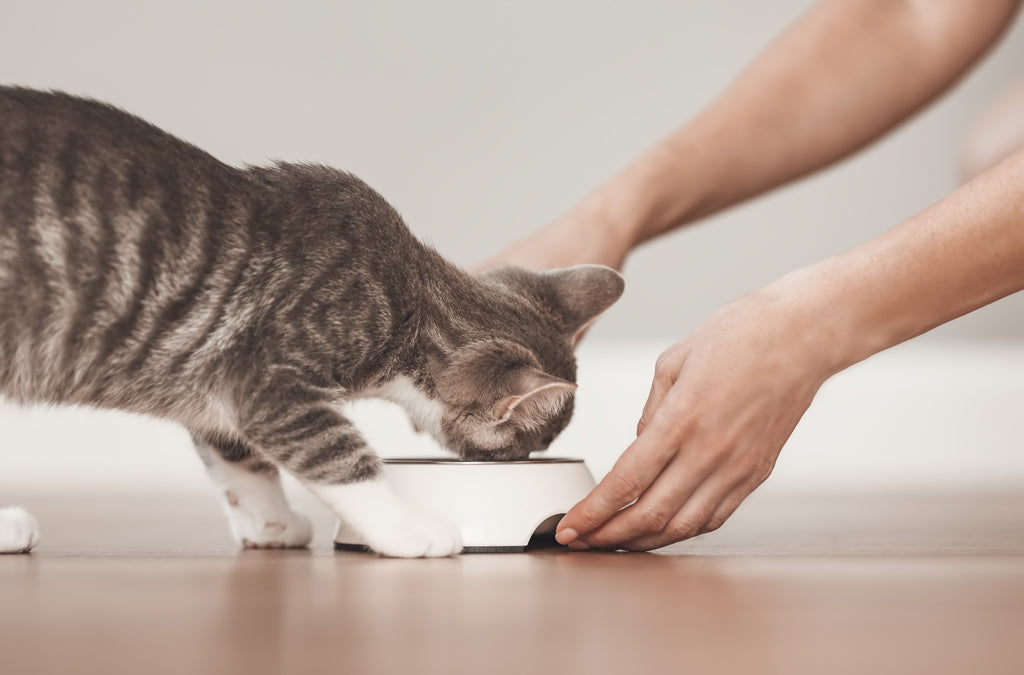
This time, we discussed cat food. While I've presented a few formulas, always keep in mind that they are guidelines. If weight loss or dietary treatment is necessary, always follow the amount recommended by your veterinarian, not an amount you calculated yourself. We recommend regular visits to the vet, even if it's just for a weight check.
Let's make sure your cat can enjoy their meals by skillfully using both dry and wet food.

![[Written by a Veterinarian] Why Are Cats Picky Eaters? A Thorough Explanation of Causes, Solutions, and Food Selection](http://www.poponeko.jp/cdn/shop/articles/shutterstock_2600037641_c61ac8f4-dd94-4d1e-9cec-6416a721a681.jpg?height=400&v=1756370137)
![[Written by a Veterinarian] What is Therapeutic Cat Food? Explaining How to Choose and Feed It](http://www.poponeko.jp/cdn/shop/articles/shutterstock_2146545975.jpg?height=400&v=1757055124)
![[Written by a Veterinarian] Celebrating Your Cat's Birthday! Choosing Safe "Cakes" and "Special Meals" and Things to Watch Out For](http://www.poponeko.jp/cdn/shop/articles/shutterstock_1968241969_aaed0797-0d45-43de-aed0-7c10696c4ce5.jpg?height=400&v=1784032801)
![[Veterinarian's Guide] Cat Escape Prevention Measures: Creating a Safe and Comfortable Environment](http://www.poponeko.jp/cdn/shop/articles/shutterstock_2035199633.jpg?height=400&v=1725783884)
![[Set] Leaf Ribbon "Fleurage" Pink & Cat Collar "Belgian Linen" Wine Rose](http://www.poponeko.jp/cdn/shop/files/2608_00119.jpg?v=1789197487&width=600 "[Set] Leaf Ribbon \"Fleurage\" Pink & Cat Collar \"Belgian Linen\" Wine Rose")
![[Set] Leaf Ribbon & Tartan Check Cat Collar (Dress Green)](http://www.poponeko.jp/cdn/shop/files/2606_00017.jpg?v=1785759845&width=600 "[Set] Leaf Ribbon & Tartan Check Cat Collar (Dress Green)")
![[Set] Leaf Ribbon & Scrunchie Cat Collar - Vidro (Aster)](http://www.poponeko.jp/cdn/shop/files/2608_00415.jpg?v=1789826564&width=600 "[Set] Leaf Ribbon & Scrunchie Cat Collar - Vidro (Aster)")
![[Slightly Damaged] Cat-Friendly Cat Warm Shirt, Border (Short Sleeve)](http://www.poponeko.jp/cdn/shop/products/DSC_7661.jpg?v=1675832922&width=600 "[Slightly Damaged] Cat-Friendly Cat Warm Shirt, Border (Short Sleeve)")
![[Set Product] Leaf Ribbon by Moda Salutations & Cat Collar by MUJI Cotton Plain - Koubai](http://www.poponeko.jp/cdn/shop/files/260618_00176.jpg?v=1784451813&width=600 "[Set Product] Leaf Ribbon by Moda Salutations & Cat Collar by MUJI Cotton Plain - Koubai")

Leave a comment