
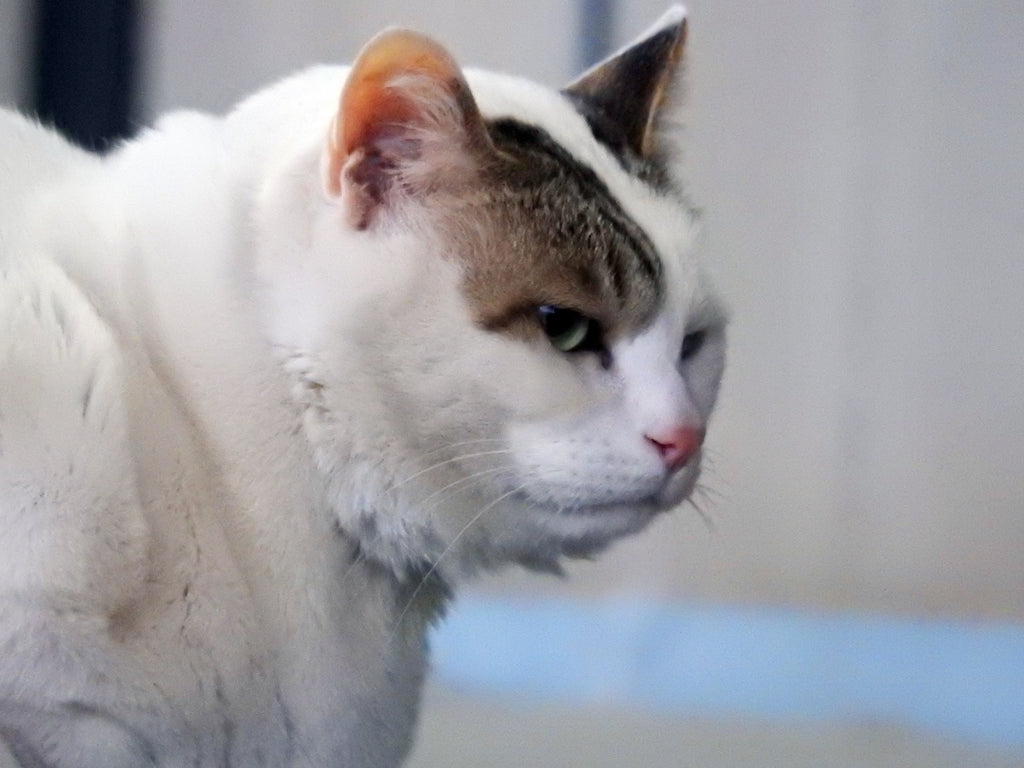
Chubby cats are endearing and absolutely adorable. Their round faces and plump bodies are simply癒される (healing) to look at.
However, obesity is not good. This time, we will focus on cat dieting and explain how to manage their diet to help them lose weight.
We will also introduce how to check your cat's obesity level, the appropriate amount and method of feeding for cats that need to diet, and effective exercise methods.
Cat obesity is the owner's responsibility
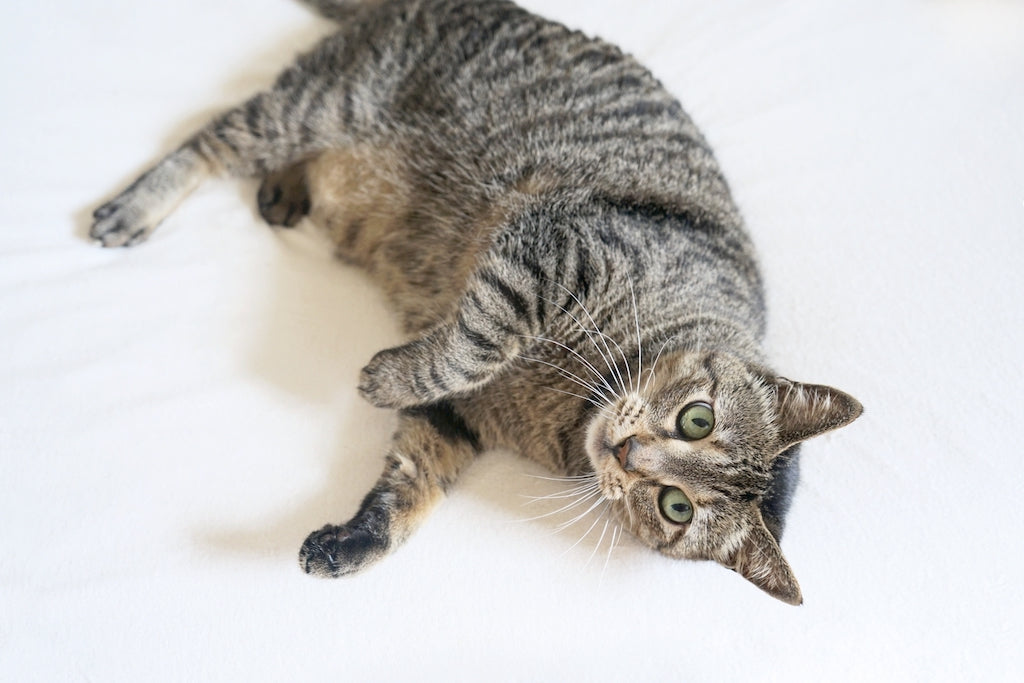
The causes of obesity in cats are "overeating" and "lack of exercise."
Kittens play a lot and expend a lot of energy. However, as they approach senior age around 7, they play less vigorously.
At the same time, their metabolism also slows down, so a diet where they eat as much as they want can lead to obesity. Also, spaying or neutering can make them gain weight due to hormonal changes.
Cats cannot manage their own diet. They also cannot arrange their living environment to prevent lack of exercise. It is important to remember that your cat's obesity is the owner's responsibility.
Cats are prone to obesity
Cats are natural sprinters. They excel at bursts of speed when pouncing on prey and are very muscular.
While they may seem immune to obesity, they live in constant energy-saving mode to exert power when it matters. Nowadays, since they don't have to hunt for food, they can quickly become overweight if they overeat or don't get enough exercise.
Obesity in cats is the root of all diseases
Just like in humans, obesity in cats increases the risk of illness. It can cause diabetes, heart disease, fatty liver, as well as arthritis and dermatitis. If you want your cat to be healthy and live a long life, you must not let them become obese.
How to check your cat's obesity level
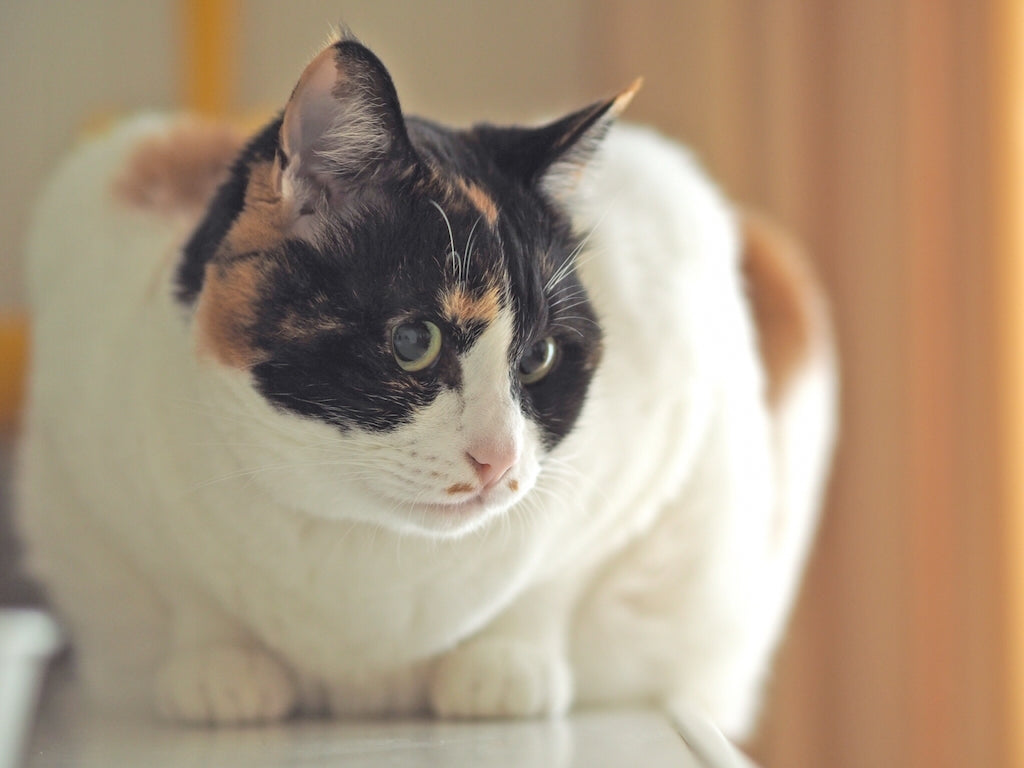
Cat obesity refers to a state where the cat is heavier than its ideal weight and has too much body fat.
Even though we talk about a cat's ideal weight, there is no fixed standard such as "over ○kg means obese" because a cat's weight varies greatly depending on its breed, sex, and physique.
Since it's difficult to assess obesity based on weight alone, the "BCS" index is used.
BCS stands for Body Condition Score, which is a method to check a cat's obesity level based on its appearance and how its body feels when touched. A cat's obesity level is assessed on a 5-point scale, with BCS 3 considered the ideal body type.
The key points are the waistline, ribs, and abdomen. Check your beloved cat's body shape, and if two or more of these indicate "slightly obese" or "obese," it's a cause for concern.
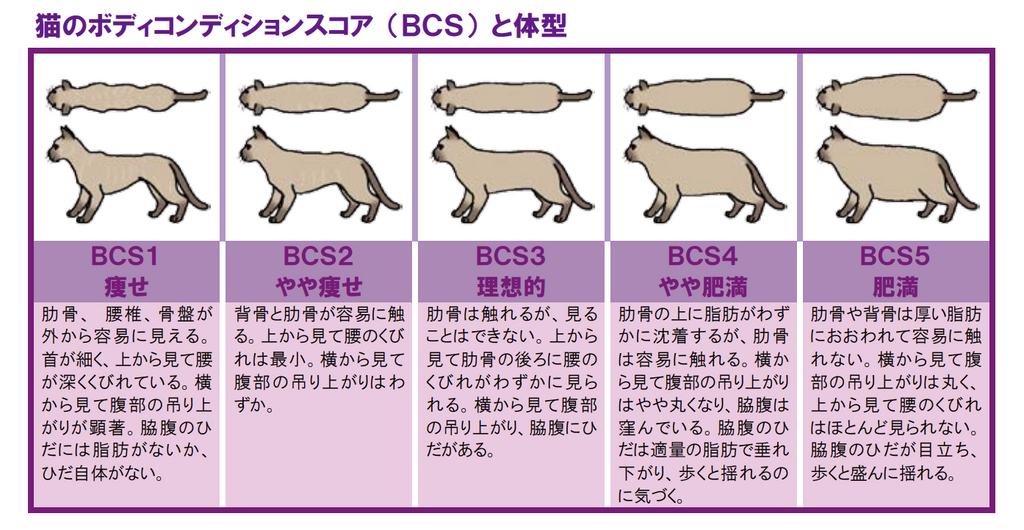
| Quote: Ministry of the Environment "Pet Food Guideline for Owners" (Japanese only) |
1. Check the waistline from directly above
When your cat is standing, look at its body shape from directly above and check its waistline.
・Standard body type
A slight waistline is visible
・Slightly obese
Waistline is indistinct and appears to bulge out to the sides
・Obese
No waistline, appears barrel-shaped
2. Check by feeling the ribs
When your cat is relaxed, try feeling around the base of its front legs with both hands. Check the obesity level by how much you can feel the ribs.
・Standard body type
Ribs can be felt, but are not prominent
・Slightly obese
A little fat, but ribs can still be felt
・Obese
Covered in fat, ribs cannot be felt
3. Check the abdomen for bulging
When your cat is standing, look at the bulging of its abdomen from the side.
・Standard body type
Abdomen and floor are almost parallel
・Slightly obese
Lower abdomen is swollen, and sways slightly when walking
・Obese
Swollen from the flanks all the way around, sways significantly when walking
Start your cat's diet
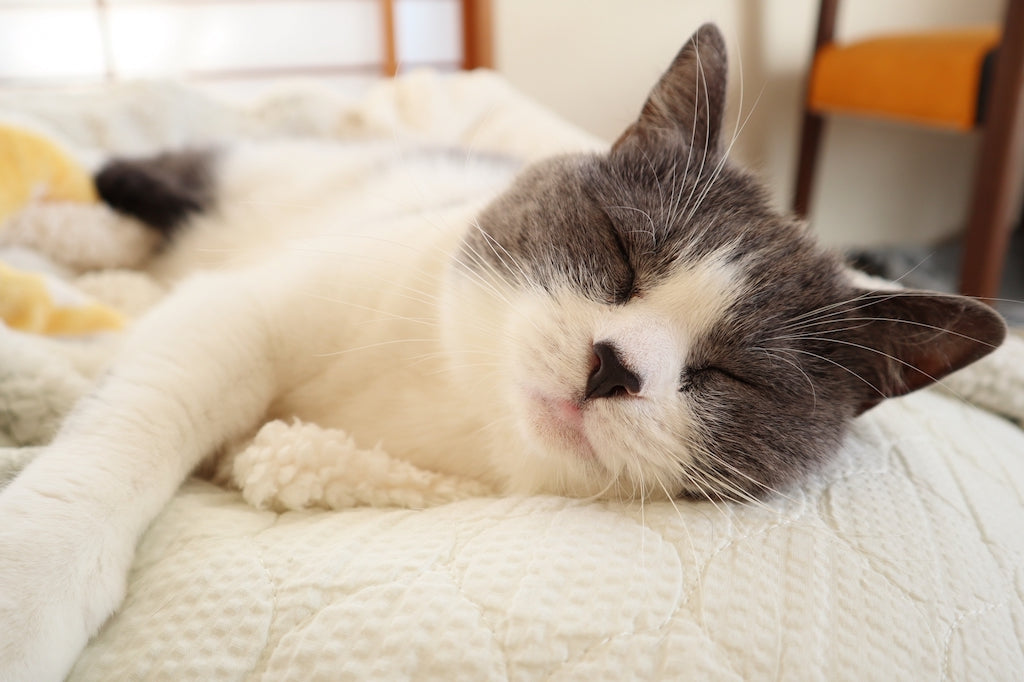
If you're concerned about your cat's obesity based on their BCS, consider starting a diet for their health.
However, rapid dieting can be very dangerous for small cats. Skipping meals or drastically reducing food intake is a no-go. Forcing a reluctant cat outside is also not advisable. The basic approach is to diet patiently over a year or more.
Essential for cat dieting are "meal portion control" and "appropriate exercise." Both require the owner's patience.
If your cat is so obese that a diet is seriously necessary, or if you're unsure whether a diet is needed, always consult a veterinarian.
Cat Diet Method 1: [Manage Food Intake]
![Cat Diet Method 1: [Manage Food Intake]](https://cdn.shopify.com/s/files/1/0414/1583/5812/files/1924912_m_78910687-4a6a-4f68-8c64-0ddf2f79eb20_1024x1024.jpg?v=1611654523)
If your cat is concerned about obesity and needs to diet, start by reviewing their food intake. It's not just about reducing the amount of food; it's about proper meal management.
Provide an appropriate amount of cat food
Cat food should not be given whenever your cat wants it; instead, you need to provide an appropriate amount based on your cat's weight and activity level.
The daily calorie requirement for an adult cat can be calculated using the formula: "80kcal × weight (kg)." For cats with less activity, try using the formula: "70kcal × weight (kg)."
Next, determine the amount your beloved cat needs from the calories per 100g listed on the cat food package. Do not estimate by eye, but measure out the necessary amount.
|
【Related Articles】 |
Reduce the amount of food
If your cat tends to be obese despite an appropriate diet, try reducing the amount of food by about 5-10%. Be careful not to reduce food intake too drastically. A pace of 1-3% weight loss per week is ideal. Adjust the food amount gradually while regularly monitoring your cat's weight.
Increase meal frequency
Prolonged hunger can lead to fat accumulation. To curb hunger, try increasing the number of meals and dividing the daily food amount into 3-4 servings. While you're away, you can use an automatic feeder or a puzzle toy that dispenses food.
Treats in moderation
It's fine to give treats, but choose low-calorie options. The appropriate amount of treats should be within 20% of the total daily calorie intake. When giving treats, reduce the main meal portion by the calorie equivalent of the treats.
Stop gobbling food
Cats instinctively eat quickly. However, eating too fast makes it difficult for them to feel full, causing them to constantly crave food. If you give in to their demands for treats, they will become obese.
For a successful diet, it's necessary to implement measures to prevent your cat from eating too quickly, such as using a food bowl with a design that makes it harder to eat from.
On social media, a diet method using plastic bottles is gaining attention. You make a hole in a plastic bottle large enough for food to come out, put food inside, and give it to your cat. The cat has to roll it with its paws to get the food out, allowing them to eat slowly. This also seems to stimulate the cat's hunting instinct.
Give diet cat food
Gradually switching to low-calorie diet cat food is also effective. Additionally, wet food is lower in calories than dry food, so using wet food in conjunction is also recommended.
Cat Diet Method 2: [Exercise]
![Cat Diet Method 2: [Exercise]](https://cdn.shopify.com/s/files/1/0414/1583/5812/files/2816339_m_1024x1024.jpg?v=1611654595)
Exercise is essential for a successful cat diet. You need to reduce calorie intake through diet management while increasing calorie expenditure through more exercise.
Unlike dogs, cats don't go for walks outside or run in dog parks. Increasing your cat's exercise requires a little ingenuity.
Play that stimulates their instincts
Gather various types of cat teaser wands and consciously invite them to play. Your cat wand technique as an owner also needs to be refined. It's also good to provide them with electric toys, puzzle toys, tunnels, and other play items.
Eat meals on a cat tree
Cats love cat trees. Not only do they provide exercise, but they also serve as a safe haven. A simple one is fine, so be sure to get a cat tree.
For cats that aren't very keen on playing, having them eat their meals on a cat tree can also be effective. Place their food bowl in a high spot to gradually increase their activity level without forcing it.
Summary
Poponeko's cat collars and cat apparel are available in L sizes, but we occasionally receive messages saying that even the L size doesn't fit.
These sizes are intended for larger cat breeds or long-haired cats, but it seems that the messages are from owners of obese cats. It feels as if the number of cats suffering from obesity is increasing.
Chubby cats are incredibly cute, but they are at risk of various diseases. To ensure they live a healthy and long life, a diet is necessary.
The most important thing for a cat's diet is to maintain appropriate portion sizes. Feeding cat food by guesswork or giving them as much as they want is a recipe for obesity.
If your cat is still a bit chubby, reduce their food intake by 5-10%. Remember, drastic diets are forbidden. Aim to diet over a year or more, and patiently tackle the diet.
Your cat's obesity is the owner's responsibility. For your cat's health, please re-evaluate their diet management and exercise methods.

Author Profile


![[Written by a Veterinarian] Why Are Cats Picky Eaters? A Thorough Explanation of Causes, Solutions, and Food Selection](http://www.poponeko.jp/cdn/shop/articles/shutterstock_2600037641_c61ac8f4-dd94-4d1e-9cec-6416a721a681.jpg?height=400&v=1756370137)
![[Written by a Veterinarian] What is Therapeutic Cat Food? Explaining How to Choose and Feed It](http://www.poponeko.jp/cdn/shop/articles/shutterstock_2146545975.jpg?height=400&v=1757055124)
![[Written by a Veterinarian] Celebrating Your Cat's Birthday! Choosing Safe "Cakes" and "Special Meals" and Things to Watch Out For](http://www.poponeko.jp/cdn/shop/articles/shutterstock_1968241969_aaed0797-0d45-43de-aed0-7c10696c4ce5.jpg?height=400&v=1784032801)
![[Set] Leaf Ribbon & Scrunchie Cat Collar - Hannari Cherry Blossom Blue](http://www.poponeko.jp/cdn/shop/files/2608_00139.jpg?v=1789197917&width=600 "[Set] Leaf Ribbon & Scrunchie Cat Collar - Hannari Cherry Blossom Blue")
![[Set Item] Leaf Ribbon & Scrunchie Cat Collar - Vidro - Lapis Lazuli](http://www.poponeko.jp/cdn/shop/files/2608_00414.jpg?v=1789826564&width=600 "[Set Item] Leaf Ribbon & Scrunchie Cat Collar - Vidro - Lapis Lazuli")
![[Set Product] Leaf Ribbon & Scrunchie Cat Collar - Champ de Fleurs - Mustard](http://www.poponeko.jp/cdn/shop/files/DSC00090_e7a82019-68d6-4981-b52a-6e8c333c0f32.jpg?v=1780663183&width=600 "[Set Product] Leaf Ribbon & Scrunchie Cat Collar - Champ de Fleurs - Mustard")
![[Set Product] Leaf Ribbon by Moda Salutations & Cat Collar by MUJI Cotton Plain - Koubai](http://www.poponeko.jp/cdn/shop/files/260618_00176.jpg?v=1784451813&width=600 "[Set Product] Leaf Ribbon by Moda Salutations & Cat Collar by MUJI Cotton Plain - Koubai")
![[Set] Leaf Ribbon & Cat Collar - Hannari Sakura Blue](http://www.poponeko.jp/cdn/shop/files/2608_00126.jpg?v=1789197917&width=600 "[Set] Leaf Ribbon & Cat Collar - Hannari Sakura Blue")
![[Set] Leaf Ribbon Fleurage Purple & Scrunchie Cat Collar Belgian Linen Turquoise](http://www.poponeko.jp/cdn/shop/files/2608_00136.jpg?v=1789197487&width=600 "[Set] Leaf Ribbon Fleurage Purple & Scrunchie Cat Collar Belgian Linen Turquoise")
Leave a comment