

The resident cat and the new cat are fighting...
When you have multiple cats, you worry about them fighting. You want them to get along, but there might be a reason for their quarrels.
This time, we will explain in detail the causes of cat fights and how to deal with them.
Causes of Cat Fights

Cats do not fight without a reason. In fact, they prefer to avoid fights, so they settle disputes with staring contests and intimidation.
When cats engage in a physical fight, there's always a good reason.
1. Territorial Disputes
Cats are highly territorial creatures. If another cat enters their territory, they will try to intimidate and drive them out.
Even indoor cats have a sense of territory. That's why resident cats and new cats sometimes fight.
For the resident cat, the entire house or room is their territory. When a new cat invades this space, it can lead to aggression.
2. Fighting over Female Cats
During mating season, male cats become aggressive. Male cats may engage in fierce fights over female cats.
|
【Related articles】 |
3. Incompatible Housemates
Cats also have their own compatibilities. Fights can escalate due to personality clashes.
Also, male cats with strong territorial instincts are more prone to fighting.
4. Stress
When a new cat arrives, the resident cat's personal space can be encroached upon.
Also, food might be stolen, or the litter box might get dirty quickly... Such changes in living conditions can cause significant stress for cats. Accumulated stress can sometimes lead to fights.
Should I Stop Cat Fights?
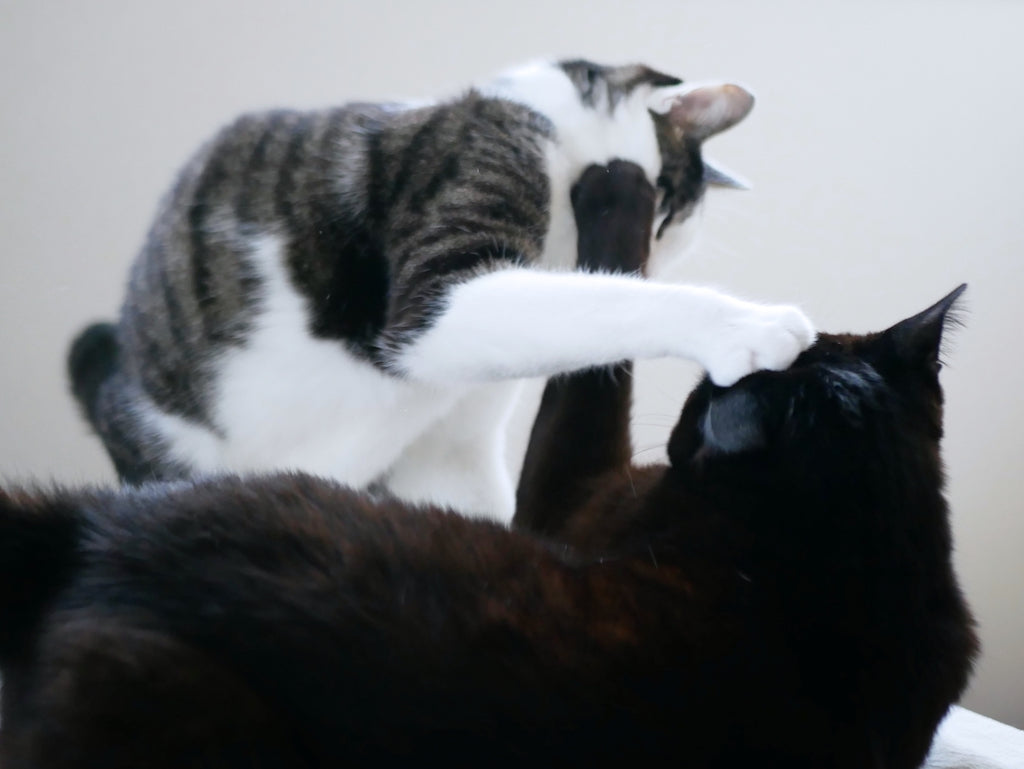
When cats start fighting, we tend to think, "I have to stop them before they get hurt."
As an owner, you might be worried, but there's no need to worry if they're just playing. Play-fighting also serves to teach them how much force to use and how to lose a fight.
Also, it's a good idea to let them be for a bit to "establish the power dynamic between the cats."
In the cat world, once the outcome of a fight is decided, they usually don't fight anymore. So, if the power dynamic is clear after a fight, they should stop fighting.
However, if serious aggression begins, the owner should intervene.
Interfering carelessly could injure the owner, so make a loud noise or block the cats' view with a cushion or tray to calm them down.
Differences Between Real Fights and Play Fights
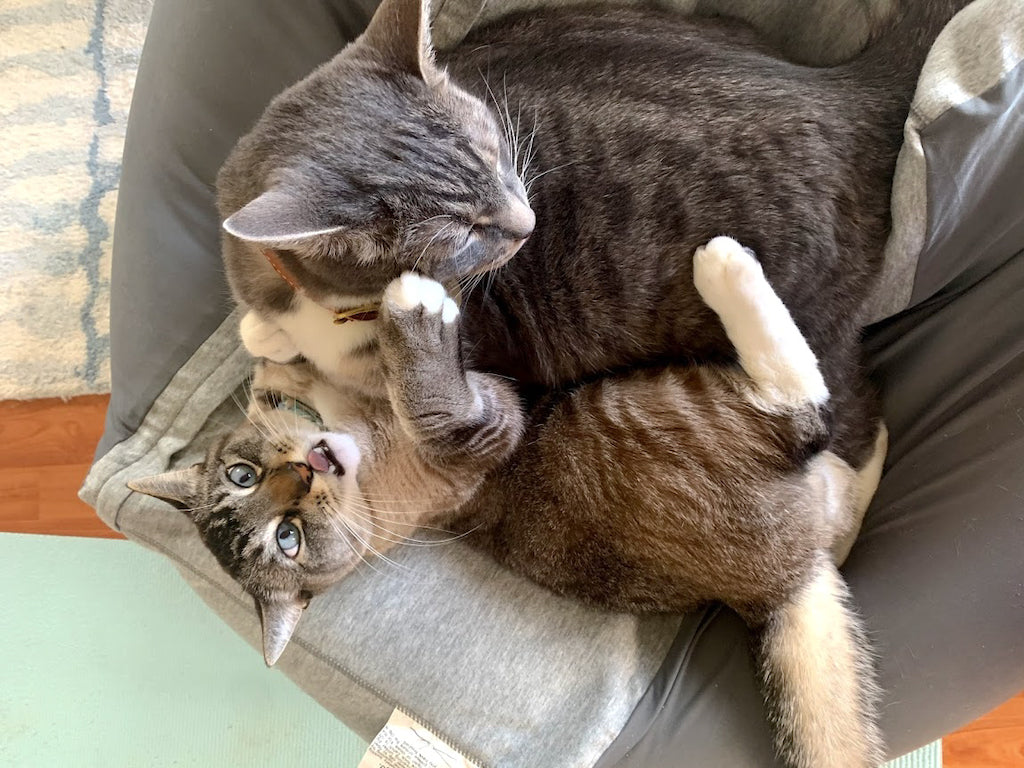
Sometimes what looks like play turns into a serious cat punch or a full-blown fight. At first glance, it can be hard to tell if it's play-fighting or a real fight.
They might be purring and allogrooming, then suddenly start growling. They might start with gentle nibbles in play, but then bite harder and harder.
In such cases, it's likely that play-fighting has escalated into a real fight.
For example, if you observe the following behaviors, you can determine it's a serious fight:
- Growling in a low voice to intimidate
- Hair standing on end
- Pupils greatly dilated
- Trying to scratch eyes or nose with claws
- Baring fangs and attempting to bite
The situation changes drastically from play, so owner intervention is necessary.
|
【Related articles】 |
How to Prevent Fights in Multi-Cat Households
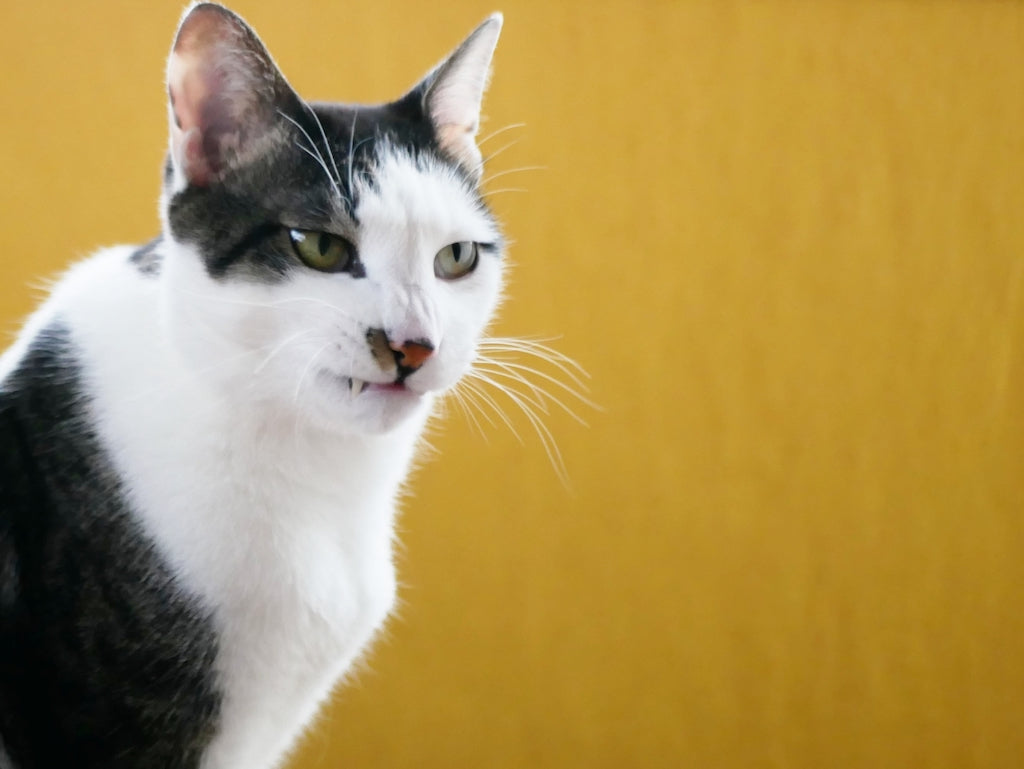
As mentioned above, fights can occur in multi-cat households. Let's consider ways to prevent fights based on their causes.
1. Observe the maximum number of cats to prevent territorial disputes
The guideline for the maximum number of cats you can keep is said to be "the number of rooms they can freely enter and exit minus 1."
Without sufficient space, territorial disputes will occur every time a new cat arrives. Also, resident cats may fight among themselves.
For this, not only horizontal but also vertical space is important. Effectively use cat trees and other items to ensure each cat has its own personal space.
2. Spay/neuter to eliminate fights over female cats
Fights during the mating season are behaviors observed in unneutered male cats. Neutering will reduce their urge to seek female cats during heat, and fights will decrease.
Additionally, there are benefits such as a calmer personality, and preventing impulsive escapes and urine spraying.
|
【Related articles】 |
3. Consider compatibility with resident cats when bringing in a new one
When welcoming a new cat, compatibility with the resident cat is very important.
For example, kittens, sibling cats, or spayed/neutered cats tend to have fewer fights and get along well.
However, an elderly resident cat may become ill when a new cat is introduced. The compatibility between elderly cats and kittens is not always good, so caution is necessary.
If you are adopting a rescue cat, a trial period offers peace of mind. In other cases, fully consider the resident cat's personality and age.
4. Create an environment that reduces stress in multi-cat households
When bringing in a new cat, it's important to be mindful of the resident cat.
First, the litter box. The more cats you have, the dirtier the litter box will get. Some cats dislike litter boxes with other cats' scents, so increase the number of litter boxes.
Also, to prevent food stealing, separate feeding places and times, and always feed the resident cat first. It's also a good idea to add more water bowls.
|
【Related articles】 |
Summary
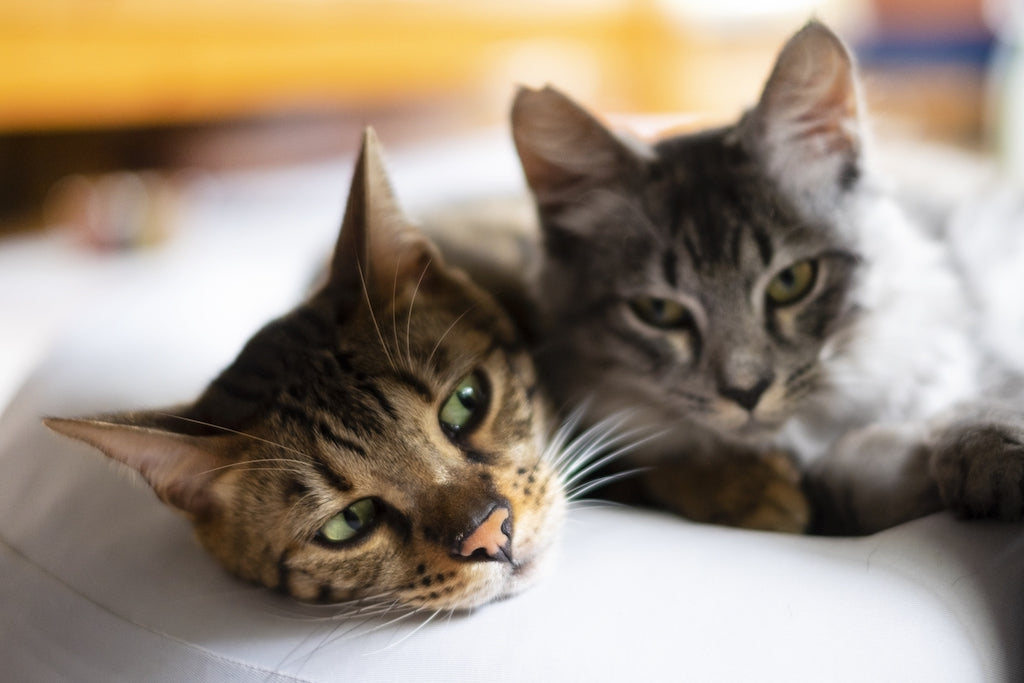
While having multiple cats brings more joy, it also comes with its own set of challenges.
It's essential to create a living environment where both resident and new cats can live comfortably. Create personal spaces where they can spend time quietly alone, and devise ways for them to maintain an appropriate distance from each other.
Also, instead of introducing them face-to-face immediately, start by exchanging scents and gradually allow them to get used to each other's presence over time.
Since cats have their own compatibilities, sometimes they become friends easily, while other times intense fights may occur. There are things owners can do, so try them patiently and without rushing.
Author Profile



![[Written by a Veterinarian] Is Buying a Cat from a Pet Store a Good Idea? Pros, Cons, and Checkpoints for Identifying a Healthy Kitten](http://www.poponeko.jp/cdn/shop/articles/petshop_cat.jpg?height=400&v=1778304000)
![[Written by a Veterinarian] Before You Worry About Your Rescue Cat Not Warming Up to You: How to Build a Bond with a Skittish Cat and Train Them to Be More Sociable](http://www.poponeko.jp/cdn/shop/articles/shutterstock_2626846741_c3619e26-699b-4722-a0b0-0c99f5414d1b.jpg?height=400&v=1778305548)
![[Written by a Veterinarian] How to Prepare for a Successful Foster Cat "Trial Period": Environment and 2-Week Schedule](http://www.poponeko.jp/cdn/shop/articles/2_a624e34a-ac59-4dfe-88cb-6a373ea44e7d.jpg?height=400&v=1778305479)
![[Written by a Veterinarian] How to tell the age of a rescue cat: Identifying "estimated age" from teeth and eyes and care by age group](http://www.poponeko.jp/cdn/shop/articles/pixta_121706085_L_547a4397-8d02-4a59-804f-238d8151b72e.jpg?height=400&v=1783812906)
![[Set] Leaf Ribbon & Cat Collar - Champ de Fleurs, Raspberry](http://www.poponeko.jp/cdn/shop/files/DSC00099_6b51f9b4-93c7-4c58-b439-108715aa361f.jpg?v=1780663183&width=600 "[Set] Leaf Ribbon & Cat Collar - Champ de Fleurs, Raspberry")
![[Set] Leaf Ribbon & Cat Collar - Petit Fleur - Pastel Blue [Limited Color]](http://www.poponeko.jp/cdn/shop/files/2608_00410.jpg?v=1789946167&width=600 "[Set] Leaf Ribbon & Cat Collar - Petit Fleur - Pastel Blue [Limited Color]")

![[Set] Leaf Ribbon & Scrunchie Cat Collar - Vidro (Aster)](http://www.poponeko.jp/cdn/shop/files/2608_00415.jpg?v=1789826564&width=600 "[Set] Leaf Ribbon & Scrunchie Cat Collar - Vidro (Aster)")
![[Set] Leaf Ribbon moda Star Spangled & Cat Collar Denim Navy](http://www.poponeko.jp/cdn/shop/files/260618_00160.jpg?v=1784451813&width=600 "[Set] Leaf Ribbon moda Star Spangled & Cat Collar Denim Navy")


保護猫(野良猫)推定8、9歳を飼い3年目にして野良猫推定3、4歳ぐらいの保護し1ヶ月程経過し、隔離から、徐々に顔合わせしてますが、オス同士てどちらも去勢済みですが、相性が良くないのか保護猫が先住猫に飛びかかって喧嘩になります。先住猫は、牙がなく、保護猫は、牙があり首元に喧嘩の度に浅いですが先住猫が傷をつきます。
その度に先住猫が怯えて隠れてしまいます。最初の喧嘩は、保護猫が逃げたので上下関係の決着がついたと思ってたのですが、そんなことでもないようで、最近は喧嘩が始まると停めてどうしてもふっかけた後輩猫の方を叱ってしまいます。
夜寝るときは別々にしてますが、今後どのようにしていけばいいのか悩んでいます。
Leave a comment