

A cat playing intently with a cat wand toy. You can clearly see how excited it is, with its eyes wide round and its nose puffed up.
It somehow feels like its " ω " area is a bit plumper than usual... or that its whiskers are all stretched out straight... or just when you think that, they suddenly droop downward.
Actually, these whiskers move in sync with the cat's feelings. In other words, you can tell how your cat is feeling just by looking at its whiskers. Wouldn't you like to know what's on your cool cat's mind?
In this article, we will explain in detail how to understand your cat's feelings through the movement of its whiskers.
The relationship between cat whiskers and feelings

Cat whiskers play the role of superior sensory organs. Also called "tactile hairs" or "sensory hairs," they are designed to sense the distance to obstacles, the movement and position of prey, and changes in temperature.
Cat whiskers are sensitive because they grow from a place about three times deeper than regular body hair and have nerves connected to their roots. Since the whiskers grow in a floating state within a blood-filled sac, they can sensitively detect even the slightest changes.
The area where a cat has the most whiskers is the " ω " part, officially called the "whisker pad" or "mystacial pad." Some owners might affectionately call this their cat's "snout" or "muzzle."
Because whisker pads are made of muscle, cats can move their whiskers freely. It is thought that when a cat is excited, it tilts its whiskers toward the object of interest, causing the base of the whiskers to bulge and the whisker pad to puff up.
In this way, a cat’s whiskers move in connection with its feelings.
|
[Related Articles] |
You can understand a cat's feelings by looking at its whiskers

In addition to the movement of their tails, ears, and meows, cats express their feelings through the movement of their whiskers. Let’s pay attention to your cat's whisker movements.
Feelings when a cat's whiskers are facing forward

A cat's whiskers face forward when it is feeling "excited and thrilled," "wants to play," or is "a little nervous."
When a cat finds something it's interested in, like a toy or a bug, its whiskers spread out wide. At this time, its ears are standing straight up and its pupils are dilated. The whiskers point intensely forward toward the toy or prey.
You can clearly see that it is concentrating all its senses to gather information about its surroundings with its whiskers. Besides when it's engrossed in play, whiskers also face forward when a cat detects danger or is feeling nervous.
Feelings when a cat's whiskers are facing backward

When a cat's whiskers are pressed flat against its face and facing backward, it means it is "scared" or "surprised."
When surprised by a loud noise—like a vacuum cleaner, a phone ringing, or the owner sneezing—a cat will direct its whiskers backward. Similarly, it pulls its ears back to defend itself.
When you see this expression, please realize that it is scared. If a cat you are meeting for the first time has its whiskers pulled back, do not try to pet it or get too close.
Cats also pull their whiskers back when eating, but this is just to keep them from getting dirty, not because they are suspicious of their food. It’s a habit unique to clean-loving cats.
Feelings when a cat's whiskers are pointing upward

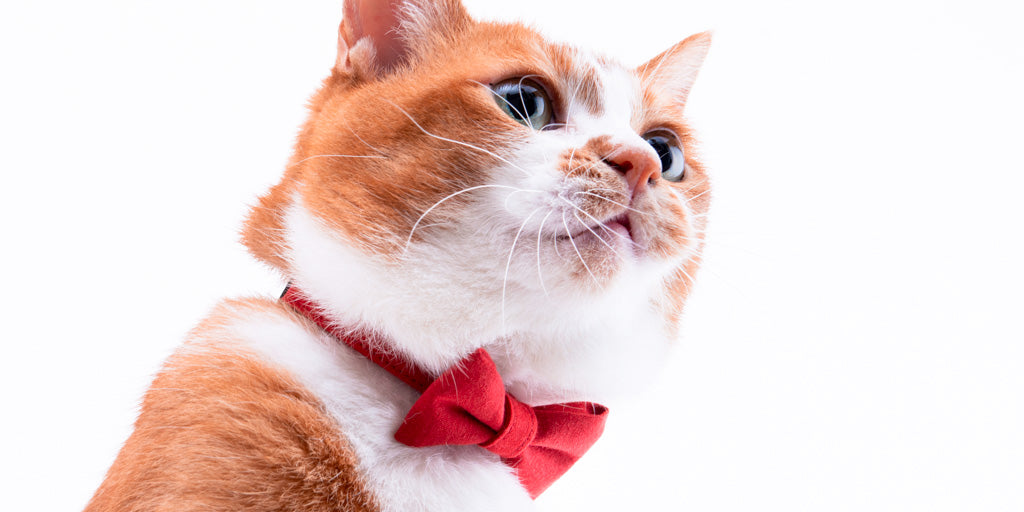
When a cat's whiskers are pointing upward, it is an expression of "I'm happy" or "I want some affection." If the whiskers on both sides are at a 10-to-2 angle, it's proof that your cat is in a good mood.
Because the corners of the mouth appear slightly lifted, the expression looks almost like it's smiling, which is very soothing.
If it approaches you with its whiskers and tail held high, that’s a sign it wants to play. Since it’s inviting you to "play with me!", please give it plenty of play time.
Feelings when a cat's whiskers are pointing downward

When a cat's whiskers are drooping downward, it is in a relaxed state, feeling "sleepy" or "bored."
If its whiskers are pointed down and it's lounging around looking bored, try showing it a toy to invite it to play. However, if it starts grooming itself in its favorite spot, that is a sign that it is extremely sleepy. Don't bother it; leave it be.
Whiskers also point downward when a cat is feeling dejected after being scolded for mischief. This is the cat’s way of expressing remorse, so please forgive it.
Summary

When you live with a cat, you notice that not only the whiskers but also the ears and tail move quite a bit.
Cats might seem like they have a poker face, but they are actually very expressive. They use their whole body to convey their feelings. While cats likely move these parts unconsciously, they serve as clues for owners to understand their cat's emotions.
If you want to know what your cat is thinking, try paying attention to the movement of its whiskers.
|
[Related Products] |





Leave a comment