

On cold winter days, when you leave your house for work or shopping, you might worry, "Is my cat cold? Will they catch a cold?"
A particular concern is your cat being left alone in winter. Should you leave the heater on, or find other ways to keep them warm? Many cat owners are probably racking their brains, worried about fire hazards and electricity bills.
This article will thoroughly explain the ideal room temperature for your cat to comfortably spend the winter, cold weather countermeasures that don't require an air conditioner, and safety management while you're away.
Are cats cold in winter too? Don't miss the signs they're feeling cold.

As the children's song "Cats curl up in a kotatsu" suggests, cats dislike the cold. Since cats' ancestors originally lived in deserts, they are relatively strong against heat but vulnerable to cold, like Japan's winters.
When your cat is feeling "cold!", they show the following signs:
- Curling up and not moving (ammonite pose)
- Fluffing up their fur
- Climbing onto your lap or into your futon
- Cold ears and paw pads
If your cat is curled up tightly or their ears are cold, it might be a sign that the room is too chilly.
Winter is a season when cats are particularly susceptible to "cat flu," such as Feline Herpesvirus (FHV) and Feline Calicivirus (FCV) infections, as well as "stomach issues" like diarrhea and loss of appetite. Taking measures against the cold is very important.
What is a comfortable room temperature for cats in winter?

The room temperature that cats find comfortable in winter is said to be around 20°C to 23°C (68°F to 73°F). This is roughly the temperature where a human would feel comfortable in a thin, long-sleesleeved shirt.
|
Adult cats: 20-23°C (68-73°F) Kittens/senior cats: 23-25°C (73-77°F) (slightly higher as they have difficulty regulating body temperature) |
In addition to temperature, humidity is also important. Winter tends to be dry, and viral activity increases, so use a humidifier to maintain 50-60% humidity.
Increasing humidity also helps prevent static electricity. Many cats dislike the zap of static electricity. (And sometimes blame their owners for it…)
For long periods away, air conditioning is recommended.

For cats living in cold regions where the temperature doesn't rise much even during the day, or for cats left alone for long periods, it's recommended to leave the air conditioner on, as it poses less risk of fire or burns.
If you set the temperature to around 20-23 degrees Celsius and put it on automatic, the optimal temperature can be maintained.
If it gets cold in the evening, you can also turn off the heating when you leave and set a timer for it to turn on in the evening.
Watch out for dryness and dehydration!
If you leave the air conditioner on, the room will inevitably become dry. Cats are not very good at hydrating themselves, so there is a concern about dehydration due to dryness.
Either use a humidifier in conjunction or place more water bowls than usual so your cat can always drink fresh water.
Cold weather対策 that can be done without air conditioning

"I'm hesitant to leave the air conditioner on for just a quick shopping trip or being away for half a day."
"I want to know about non-electric measures in case of a power outage."
"I turn off the air conditioner when I sleep at night, so I'm worried if it's cold."
For such owners, here are some cold weather measures that can be taken without an air conditioner.
Turn off the heating right before you leave.
For absences of about half a day, a kotatsu or heated mat is convenient. Warm it up on "high," then turn it off and unplug it just before you leave. It will stay warm for a while, allowing your cat to freely warm up.
Since a kotatsu can pose a risk of oxygen deprivation, it's safest to lift the blanket to create an opening. When using a heated mat, placing a blanket that your cat can burrow into will help them stay warm longer.
"Pet-specific kotatsu" or "pet heaters" with adjustment functions that automatically turn off when a certain temperature is reached are also convenient.
Prepare a dome-shaped bed or cardboard box.
A roofed "dome-shaped bed" or "cylindrical bed" retains heat well, allowing your cat to stay warm with their own body heat.
If you don't have a specialized bed, simply putting a blanket in a cardboard box can create an excellent warm space. Making the entrance a little narrower will help retain the warmth even more.
Prepare a pet-friendly hot water bottle.
"Pet-friendly hot water bottles," either the type you fill with hot water or the type you warm in the microwave, have no power cords, so there's no concern about electric shock or fire. They offer peace of mind when your cat is left alone in a cage or during cold nights.
To prevent low-temperature burns, always wrap it in a special cover or a thick towel and place it in their bed.
Secure a sunny spot.
For daytime absences, sunlight is the best heating. Place your cat's bed near a sunny window. However, since window areas cool down rapidly after sunset, if you're away in the evening, it's important to also create a warm refuge away from the window.
Troubles to watch out for in winter

Heating appliances are essential for protecting your cat from the winter cold. However, there are a few things to be careful of when you're away.
Fire
Oil stoves, gas fan heaters, and halogen heaters pose a fire hazard, so avoid using them when you're not home. It's also safer to unplug them to prevent them from accidentally turning on.
Burns
Heating appliances like stoves and heaters can cause burns if your cat touches them. When you are home, fence them off, and do not use them when your cat is home alone.
Also, when using heated mats or pet heaters, be careful of "low-temperature burns." Use them on a low setting and make sure your cat's skin doesn't come into direct contact with them. Do not use them in a way that traps your cat without an escape from the heat, or for long periods with cats who are immobile.
Electric shock
If your cat chews on the power cord of a heating appliance, there's a risk of electric shock. Cover power cords and unplug them when you're away.
Dehydration and Dryness
When using air conditioning, the room becomes very dry. Your cat could suffer from dehydration, so use a humidifier to maintain about 50-60% humidity. This also helps prevent infections and static electricity. Additionally, it's a good idea to add more water bowls to ensure your cat can drink plenty of water.
Summary

The cold of winter can be a major cause of illness for cats. When your cat is home alone or when you go to bed at night, keep the following points in mind to prepare for them:
- Aim for a room temperature of 20-23°C (68-73°F) and humidity of 50-60%.
- If no air conditioner, use a dome-shaped bed or hot water bottle.
- For long absences, use air conditioning and don't forget anti-dryness measures.
- Stoves and other fire-based heating appliances are NOT allowed while you're away.
- Beware of burns and electric shock (unplug when not in use).
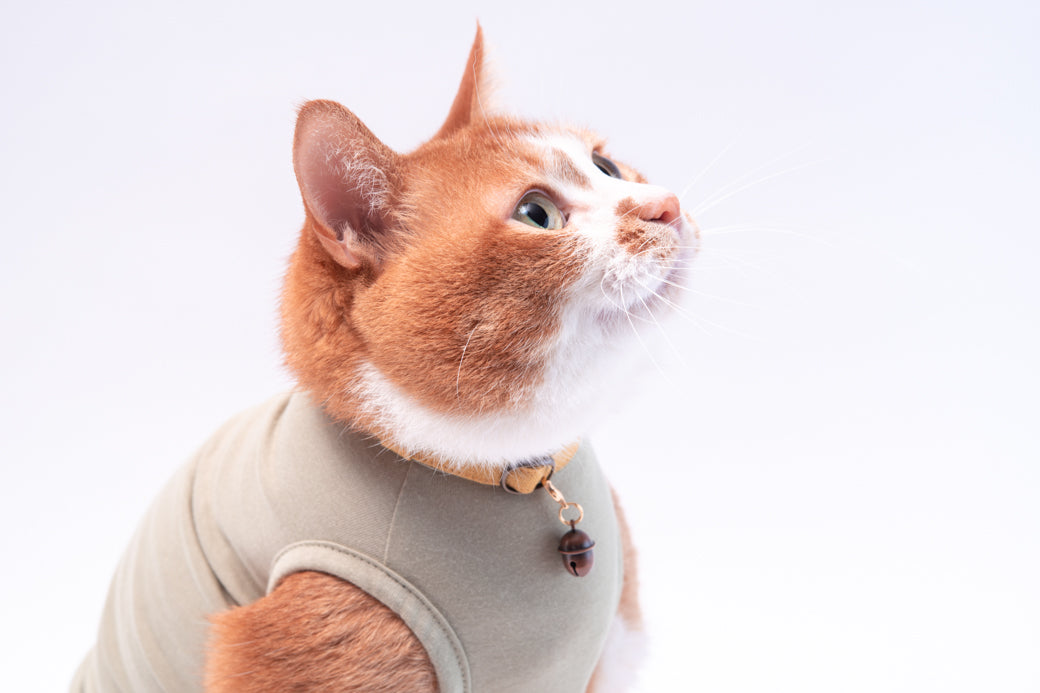
For cats that are sensitive to cold, or kittens and senior cats who have difficulty regulating their body temperature, dressing them in warm cat clothing is one option.
Let's take thorough measures against the cold and get through winter in good health!
|
【Related Products】 |
|
【Related Articles】 |

![[Vet-supervised] Cat hates wearing a collar? Reasons why and how to get them used to it](http://www.poponeko.jp/cdn/shop/articles/a0fdc9ee82de7f01afb932f1e1e60236_da240718-be68-4e99-8a8c-64449f63d83e.jpg?height=400&v=1780975808)

![[Preservation Edition] Cat Evacuation and Disaster Preparedness Guide | How to Evacuate Together and a Checklist of Items You Need Now](http://www.poponeko.jp/cdn/shop/articles/shutterstock_2416909603_396ccf81-25ff-4b28-a40f-9b7ce9ae8797.jpg?height=400&v=1785383138)
![[Set] Leaf Ribbon & Scrunchie Cat Collar, Gingham Check, Blue](http://www.poponeko.jp/cdn/shop/files/DSC00092_346b4b0c-da46-4b7b-b5e9-8ab3dafb6534.jpg?v=1780663891&width=600 "[Set] Leaf Ribbon & Scrunchie Cat Collar, Gingham Check, Blue")
![[Set] Leaf Ribbon & Scrunchie Cat Collar, Gingham Check, Tomato Red](http://www.poponeko.jp/cdn/shop/files/DSC00091_c37cc8a7-d056-4cf1-a8ec-9defb7c0c502.jpg?v=1780663891&width=600 "[Set] Leaf Ribbon & Scrunchie Cat Collar, Gingham Check, Tomato Red")
![[Set] Leaf Ribbon moda Old Glory & Cat Collar Okayama Kojima Denim Black](http://www.poponeko.jp/cdn/shop/files/260618_00167.jpg?v=1784451812&width=600 "[Set] Leaf Ribbon moda Old Glory & Cat Collar Okayama Kojima Denim Black")
![[Set Item] Leaf Ribbon & Scrunchie Cat Collar - Vidro - Lapis Lazuli](http://www.poponeko.jp/cdn/shop/files/2608_00414.jpg?v=1789826564&width=600 "[Set Item] Leaf Ribbon & Scrunchie Cat Collar - Vidro - Lapis Lazuli")
Leave a comment