
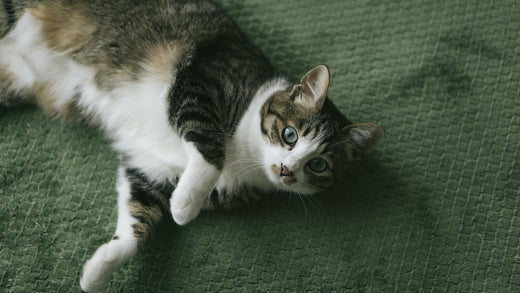
When a cat enters estrus, they become restless and anxious. In addition to this, problematic behaviors such as loud meowing and urine spraying become noticeable.
However, estrus-specific behaviors are driven by reproductive instinct, so scolding them won't stop them.
How can we deal with problematic behaviors during estrus? We will explain in detail what cat owners can and cannot do regarding their cat's estrus.
When and for how long do cats go into heat?

Cats typically experience their first estrus around 6-8 months of age for females and 9-12 months of age for males. There is significant individual variation, so some cats may go into heat earlier.
Cats are "seasonally polyestrous" animals, meaning they go into heat during seasons that are conducive to raising young: spring (February-April) and summer (June-August). During the warmer months, you might hear "nao~n" or "gyao~n" cries from outside.
First, female cats go into heat and start making distinctive loud meows. Then, they begin urine spraying in various places.
This is to attract male cats, who respond to the female's meows and pheromones by going into heat themselves.
How long does a cat's estrus last?
A cat's estrus cycle continues throughout its life. While there is individual variation, female cats appear to be able to become pregnant and give birth until around 8 years old. Male cats seem to retain reproductive capability until around 15 years old.
Duration of a cat's estrus
The estrous cycle of a female cat repeats through "proestrus" → "estrus" → "metestrus" → "anestrus."
The period from "proestrus" to "metestrus," when estrus-specific behaviors are observed, lasts about 14-21 days. If mating does not occur during this period, the next estrus will begin in about 2-3 weeks.
Incidentally, a cat's gestation period is about two months. After giving birth, the cat can become pregnant again two months later when the kittens are weaned. In other words, cats are highly reproductive creatures, capable of giving birth multiple times a year.
Things to watch out for during a cat's estrus

Even indoor-only cats will experience estrus.
Even indoors, you'll hear howling-like meows, and the scent of female cats in heat will waft in with the outside air. Their urge to go outside will become strong, so escaping is a concern.
Besides traffic accidents, there's a risk of injury from fights between male cats. There's also the concern of infections from mating.
Of course, letting your cat outside just because they're being noisy is also a no-go.
During the spring and summer estrus periods, be extra diligent about preventing escapes. For emergencies, attach a cat collar and ID tag to prevent them from getting lost.
|
[Related Articles] |
NG behaviors to avoid with a cat in heat
During a cat's estrus, problematic behaviors become noticeable, such as loud, howling-like meows, urine spraying everywhere, and becoming aggressive. Sometimes, they may meow all night long.
However, there are things you should not do to a cat in heat, even if you want to stop the problematic behavior.
Scolding or startling them with loud noises
You cannot stop a cat's noisy meows or urine spraying during estrus by scolding them. Startling them with loud noises or voices is a no-go as it will cause further stress.
Giving them catnip
While there is a method of distracting them by giving them catnip, excessive amounts can cause respiratory distress. It can also intensify their excitement and aggression, so catnip is not recommended.
Stimulating with a cotton swab
Female cats ovulate and end their estrus cycle through mating. Information circulates about stimulating a female cat's genitals with a moistened cotton swab to hasten the end of estrus, but this is an extremely dangerous act. Absolutely do not do it.
Estrus prevention for cats

Once a cat's estrus has begun, you can only wait for it to subside naturally. Even if it's considered problematic behavior, it's driven by the cat's instincts and cannot be stopped.
To manage your cat's estrus effectively, learn some useful estrus prevention methods.
Avoid contact with other cats
Even indoor cats can go into heat more easily if they react to outdoor cats in heat. To avoid contact with other cats, it's necessary to cover windows with curtains or move cat trees away from windows.
Play a lot
Cats in heat are emotionally unstable and stressed from frustration. To distract them, provide toys that pique their curiosity. If they play a lot and use up their energy during the day, you can reduce their nighttime meowing.
Increase the number of scratching posts
During estrus, cats mark their territory by scratching more than usual. Provide more scratching posts so they can scratch as much as they like.
Don't over-fuss
Female cats in heat may become more persistent in seeking affection. While it's very cute, over-fussing can worsen problematic behaviors during estrus. During this period, avoid over-fussing and gently move away even if they try to cuddle.
Urination countermeasures
Cats have a habit of repeatedly marking spots where they have urine sprayed. Clean thoroughly to ensure no odors remain. It's recommended to place pet sheets or waterproof sheets if possible.
Spay/neuter surgery if no breeding is planned

Problematic behaviors and emotional instability during estrus can be alleviated by undergoing spay/neuter surgery.
It can prevent unwanted pregnancies and help reduce the strong odor of urine. It is also said that male cats' aggressive personalities become milder.
Above all, it can prevent hormone-related diseases such as mammary cancer, ovarian cancer, pyometra, testicular cancer, and benign prostatic hyperplasia.
However, even with spay/neuter surgery, estrous behavior may not completely disappear.
While there are drawbacks such as the risk of general anesthesia and a tendency to gain weight, if you plan to live with your cat for a long time, the benefits of spay/neuter surgery are significant.
Ideally, consider spay/neuter surgery before the first estrus, around 6-8 months of age.
|
[Related Articles] |
Summary

A cat's estrus period occurs twice a year, in spring and summer, lasting approximately 14 to 21 days. The first estrus occurs around 6 months of age, and estrus will continue to occur throughout their life.
Estrus-specific behaviors such as "noisy meowing" and "urine spraying" are problematic for humans. However, you cannot stop them by scolding them or making them end quickly.
The important thing in managing estrus is to prevent escapes. Then, you can wait for estrus to subside by measures such as blocking the view to the outside, expending energy through play, and not over-fussing.
Estrus is also a stressful phenomenon for cats. If there are no plans for breeding, spay/neuter surgery is the most effective estrus management strategy. For your cat's physical and mental health, consider spay/neuter surgery as early as possible.


![[Vet-supervised] Cat hates wearing a collar? Reasons why and how to get them used to it](http://www.poponeko.jp/cdn/shop/articles/a0fdc9ee82de7f01afb932f1e1e60236_da240718-be68-4e99-8a8c-64449f63d83e.jpg?height=400&v=1780975808)

![[Preservation Edition] Cat Evacuation and Disaster Preparedness Guide | How to Evacuate Together and a Checklist of Items You Need Now](http://www.poponeko.jp/cdn/shop/articles/shutterstock_2416909603_396ccf81-25ff-4b28-a40f-9b7ce9ae8797.jpg?height=400&v=1785383138)
![[Set] Leaf Ribbon & Cat Collar - Gingham Check Tomato Red](http://www.poponeko.jp/cdn/shop/files/DSC00105_c3cf26db-19e7-4828-a848-34b8c51cbf24.jpg?v=1780663891&width=600 "[Set] Leaf Ribbon & Cat Collar - Gingham Check Tomato Red")
![[Set] Leaf Ribbon & Cat Collar - Gingham Check Yellow](http://www.poponeko.jp/cdn/shop/files/DSC00108_0dcb125b-7ca2-4c51-a9c7-a1544ae1f9c9.jpg?v=1780663891&width=600 "[Set] Leaf Ribbon & Cat Collar - Gingham Check Yellow")
![[Set Product] Leaf Ribbon & Scrunchie Cat Collar - Tartan Check Black Watch](http://www.poponeko.jp/cdn/shop/files/2606_00011.jpg?v=1785759845&width=600 "[Set Product] Leaf Ribbon & Scrunchie Cat Collar - Tartan Check Black Watch")
![[Set] Leaf Ribbon moda Lydia Lace & Cat Collar Ayakasuri Akane](http://www.poponeko.jp/cdn/shop/files/260618_00159.jpg?v=1784451813&width=600 "[Set] Leaf Ribbon moda Lydia Lace & Cat Collar Ayakasuri Akane")
![[Set] Leaf Ribbon & Tartan Check Cat Collar (Dress Green)](http://www.poponeko.jp/cdn/shop/files/2606_00017.jpg?v=1785759845&width=600 "[Set] Leaf Ribbon & Tartan Check Cat Collar (Dress Green)")
![[Set Item] Leaf Ribbon & Scrunchie Cat Collar - Petit Fleur - Mint](http://www.poponeko.jp/cdn/shop/files/2608_00417.jpg?v=1789946167&width=600 "[Set Item] Leaf Ribbon & Scrunchie Cat Collar - Petit Fleur - Mint")

メス猫ひきとることになったのだが
ずっとついてきてずっとくっついてくるのだが
これは発情なのだろうか
避妊手術は危険なのですかね?
今 発情期 真っ只中で1日中 鳴いてうるさいです❗️ある年齢になったら無く成る、、💦と自分 勝手に 思っていましたが そうでは無いのですね~😅勉強になりました 有り難うございます❗️🙏
とても参考になりました。猫ちゃんの発情期にやっていいこといけないこと他のには書いてないことがたくさん書いてありとても参考になりました。ありがとうございます。
可愛そうでしょうがないですが去勢まで見守りたいと思います
愛猫のゆきみ(♀生後7ヶ月)の行動がいつもと全然違って、もしかしたら発情かも、と思い調べていたらこちらの記事に辿り着きました。
ゆきみも私も初めてのことなので不安でいっぱいでしたが、とても参考になり、安心できました。
早速動物病院の受診をしようと思います。
ありがとうございます!
Leave a comment