

A cat's fluffy fur is one of its charms. Just petting them is enough to make you feel relaxed.
So, it's natural for many cat owners to be surprised if they find a "bald spot" on their cat's body. You'd probably worry, "Is it a disease?" or "Is it due to stress?"
This time, we will focus on cat baldness and explain in detail the causes of hair loss, diseases that cause hair to fall out, and "stress-induced alopecia," which can be difficult to distinguish.
What Causes Bald Spots in Cats?

Cats have a "shedding season" in spring and autumn, during which hair loss naturally increases.
However, if you notice partial bald spots or noticeably excessive hair loss outside of shedding season, it could be a sign of some kind of abnormality in their body.
The causes of bald spots in cats can be broadly classified into the following three categories:
- Bald spots caused by skin diseases: Parasites such as fleas and mites, food allergies and atopic dermatitis, cat ringworm (dermatophytosis), etc.
- Bald spots caused by stress: Hair loss due to psychological stress, "over-grooming" where the cat continuously licks its body due to anxiety or frustration, etc.
- Other causes: Endocrine diseases, aging, nutritional imbalances, physical friction from collars, etc.
Even if it's the same "bald spot," the causes vary, so observing "whether there is itching" and "which part of the body it's on" is a big clue to identifying the cause.
|
【Related articles】 |
Symptoms of Baldness in Cats and Potential Diseases

The suspected diseases vary depending on the area where the bald spot appears and other symptoms.
To identify the cause of your cat's baldness, observing which part of the body has a bald spot and what other symptoms are present provides significant clues.
Baldness above the eyes and at the base of the ears
Baldness around the face suggests "food allergies." Hair loss is seen above the eyes, on the forehead, and at the base of the ears, along with rashes and itching, and may also be accompanied by digestive symptoms such as diarrhea and vomiting. Caution is advised if symptoms appear after feeding a different food than usual.
If the cat is particularly scratching its ears, otitis externa or ear mites may be suspected.
Circular bald spots on the face and limbs
"Dermatophytosis", also known as cat ringworm, is a disease where circular hair loss occurs on the face and limbs due to infection with fungi.
Although itching is usually not severe, it is characterized by entire tufts of hair falling out. If left untreated, it can spread throughout the body and also be transmitted to humans, so early veterinary attention is necessary.
Baldness on the edges of the ears
"Mange" caused by mite infestation is accompanied by severe itching, and hair loss and scabs may appear on the edges of the ears.
Additionally, white-furred cats can develop "photosensitivity", which causes hair loss at the tips of their ears due to UV light exposure.
Bald spots on the back and at the base of the tail
Flea bites can cause severe itching, leading to "flea allergy dermatitis." The typical pattern is hair loss on the back, at the base of the tail, and around the neck from excessive scratching.
Linear bald spots on the body
"Linear granuloma," a type of skin disease called eosinophilic granuloma complex, also causes bald spots. It is characterized by bumpy skin on the hind legs and linear baldness. It also tends to occur on the abdomen, inner thighs, and neck.
Baldness on the abdomen, hind legs, and back
This pattern is highly likely to be "stress-induced alopecia (psychogenic alopecia)." It is characterized by bald spots concentrated in areas that the cat can easily lick.
What is Stress-Induced Alopecia (Psychogenic Alopecia) in Cats?

When cats feel intense anxiety or stress, they may continuously lick their bodies to calm themselves. This behavior is called "over-grooming," and repeated licking can lead to hair loss and even skin irritation.
This condition is also known as "psychogenic alopecia," "licking dermatitis," or "licking injury."
Over-grooming is considered one of the "stereotypic behaviors" that cats engage in to cope with anxiety.
Stress can be caused by the following factors:
- Changes in living environment, such as moving or rearranging furniture
- New family members (people or animals) have been added
- Poor compatibility with other cats or animals in the household
- Frustration due to lack of exercise or play
- Long periods of being left alone
What's tricky is that baldness due to infections or allergies is often noticeable because the cat scratches, but stress-induced alopecia often involves quiet licking, and it's not uncommon for owners to only realize their cat is bald after the fact.
If bald spots are concentrated on areas that the cat can easily lick, such as the abdomen, inner thighs, hind legs, or back, suspect stress-induced alopecia.
|
【Related articles】 |
Watch out for baldness caused by collars too.

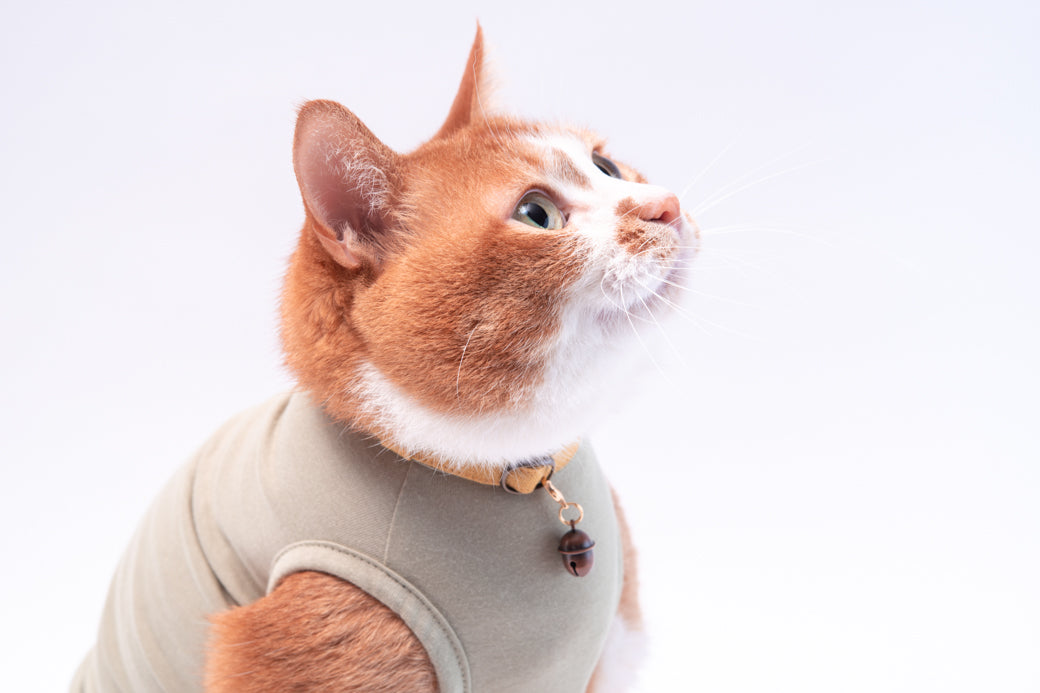
Often overlooked, if a cat's collar is too heavy or stiff, it can rub against the neck and cause "collar baldness."
If the hair follicles are damaged, hair may not grow back, so choosing a light and soft collar that fits your cat's neck is one way to prevent this.
Also, if a cat collar is left unsanitary, it can not only cause an unpleasant odor but also lead to skin problems due to bacteria, so caution is needed.

▲Cat with baldness around the neck
|
【Related articles】 |
Treatment for Baldness in Cats

Baldness and excessive hair loss in cats are "signs of discomfort." If you notice them, consult a veterinarian as soon as possible.
When you do, it will be helpful for the diagnosis if you make a note of where on the body the baldness is, what it looks like, and how often the cat is licking or scratching.
At the veterinary clinic, the cause will be investigated through examinations such as a physical exam, skin test, and blood test, and then a treatment plan will be determined.
- If the cause is a skin disease: Treatment appropriate for the cause, such as deworming medication, antifungal medication, or dietary therapy for allergies.
- If it's stress-induced alopecia: Use medication to suppress itching, and in some cases, anti-anxiety medication, while simultaneously reviewing the living environment.
In both cases, an "Elizabethan collar" may be used to prevent the cat from licking the affected area.
The key to treating stress-induced alopecia is not to rely solely on medication, but to gradually eliminate the sources of stress. However, identifying these causes is not easy, so it requires persistent effort in consultation with a veterinarian.
|
【Related Products】 |
How to Prevent Baldness in Cats

Here are some key points to consider for preventing baldness.
- Regularly administer flea and tick prevention medication.
- Keep your cat's body and living environment clean.
- Detect skin abnormalities early through frequent brushing and interaction.
- Provide an environment where your cat can relieve stress with toys, cat trees, and scratching posts.
- Choose a light and soft collar that is comfortable for your cat.
It's often hard to notice skin problems at a glance, so it's a good idea to make a habit of touching and checking their skin during daily interactions for peace of mind.
Summary

The causes of baldness in cats vary, ranging from skin diseases like fleas, mites, and allergies, to over-grooming due to stress, and friction from collars.
Especially with stress-induced alopecia, clear signs like "itching" are often absent, and it's not uncommon for bald spots to have spread by the time they are noticed.
Beneath their fluffy fur, skin problems can be surprisingly hard to detect. Make sure to regularly check the condition of their skin through daily brushing and interaction.
If you notice any abnormal bald spots or hair loss, don't wait—consult a veterinarian promptly.

![Why Does My Cat Need a Collar? [Disadvantages and Their Solutions]](http://www.poponeko.jp/cdn/shop/articles/DSC_9121-2_f7898a9b-8f8c-4864-921f-55ea7577a6b8.jpg?height=400&v=1764335616)
![Feline Infectious Peritonitis (FIP) Treatment Guide [2024 Edition]: Latest Information and Treatment Options](http://www.poponeko.jp/cdn/shop/articles/shutterstock_1633580878.jpg?height=400&v=1727181737)
![[Set Item] Leaf Ribbon & Scrunchie Cat Collar, Petit Fleur, Pink](http://www.poponeko.jp/cdn/shop/files/2608_00405.jpg?v=1789946167&width=600 "[Set Item] Leaf Ribbon & Scrunchie Cat Collar, Petit Fleur, Pink")
![[Set Product] Leaf Ribbon & Cat Collar - Gingham Check Green](http://www.poponeko.jp/cdn/shop/files/DSC00113_9928b03b-5bce-4bf5-b54f-3a4ef263fb16.jpg?v=1780663891&width=600 "[Set Product] Leaf Ribbon & Cat Collar - Gingham Check Green")
![[Set] Leaf Ribbon & Cat Collar - Arabesque Swirl, Red](http://www.poponeko.jp/cdn/shop/files/2608_00117.jpg?v=1789044775&width=600 "[Set] Leaf Ribbon & Cat Collar - Arabesque Swirl, Red")
![[Set] Leaf Ribbon & Cat Collar - Gingham Check Orange](http://www.poponeko.jp/cdn/shop/files/DSC00109_9b2822dd-1b99-4744-982e-5a48c8c1f667.jpg?v=1780663891&width=600 "[Set] Leaf Ribbon & Cat Collar - Gingham Check Orange")

Leave a comment