
Hello, this is Kuriyama from Poponeko.
It was just the other night, February 13th. I was looking through the feature on cats and disaster preparedness in "Nekobiyori March Issue" when my smartphone's earthquake early warning alarm blared, and a strong tremor hit.
Even though I was scared, all I could think about was my cat.
Cats, with their keen sense of danger, can be startled by an earthquake and bolt outside. Even with this earthquake, I saw many Twitter users posting "my cat ran away."
If your cat escapes, how do you find them? Can you reunite with your cat during a major disaster?
The third installment of this series will focus on "Actions to Take When Your Pet Escapes or Gets Lost."
|
【Related Articles】 |
Sometimes Evacuation with Pets is Not Possible
In the event of a disaster, "evacuation with pets" is the general rule. Not leaving your pet behind is the first step in preventing them from getting lost.
However, during unpredictable disasters such as earthquakes, it can sometimes be difficult to evacuate with pets.
For example, if a disaster strikes while the owner is out. The Great East Japan Earthquake occurred during the daytime on a weekday, so many owners were out for work or other reasons.
I also had difficulty returning home from work, and didn't make it back until the evening of the next day.
Also, there are times when emergency evacuation is necessary. There was no time to take pets during a tsunami, or pets had to be left behind due to a nuclear power plant accident. It's very painful, but these are actual cases that occurred during the Great East Japan Earthquake.
Create a hiding place for your cat
There have also been cases where cats went into hiding and couldn't be evacuated with their owners. It's reassuring to have a designated place where you know "the cat will be found here" in an emergency.
Cats are very sensitive all over their bodies, so they love narrow, dark places where they can hide completely. Prepare a safe zone for your cat by stuffing a blanket into a hard-shell carrier.
If there's a "place for your cat to hide," there will be fewer instances of them bolting outside in a panic from an earthquake.
Many pets went missing during the Great East Japan Earthquake
Many cats went missing during the Great East Japan Earthquake. Health centers and animal welfare centers reportedly received numerous lost pet reports immediately after the disaster.
During a disaster, cats tend to panic. They may dart outside from unexpected places. They could also get out through broken doors or warped windows.
Will a lost cat return?
During the Great East Japan Earthquake, of the animals taken in by public health centers and animal welfare centers, only 41.0% of dogs and 5.4% of cats were returned to their owners.
■Rescue activities for stray and injured animals
|
Dogs |
Cats |
|
|
Number Protected |
2,838 |
2,931 |
|
Number Returned |
1,163 |
159 |
|
Return Rate |
41.0% |
5.4% |
*Status from March 2011 to September 2012
*Total for Aomori, Iwate, Miyagi, Sendai, Fukushima, Koriyama, Iwaki, Ibaraki, Tochigi, and Chiba prefectures
*Created from Ministry of the Environment's "Record of Disaster Animal Response in the Great East Japan Earthquake"
For cats, it seems difficult to distinguish whether they are pets or cats that originally lived outdoors.
Also, there are cases where cats returned to their owners on their own, or owners found their cats on their own, so the actual return rate might be a bit higher.
However, I was shocked by this low return rate.
Cat collars and microchips are essential
Even if you get separated from your cat during a disaster, you should take measures to ensure your cat can return safely.
What identifies a lost cat are their "cat collar" and "microchip." They are like good luck charms that greatly increase the chances of reunion.
Precisely because cats have a high risk of escaping, we must protect their lives with cat collars and microchips.
It's difficult to identify cat owners
As an example for dogs, during the Great East Japan Earthquake, 100% of the owners of dogs wearing ID tags or registration tags were identified.
■Status of owner identification, etc. (dogs)
|
Number of Dogs with Identification |
Owner Identified |
|
|
Collar only |
614 |
3 |
|
ID tag |
4 |
4 |
|
Registration tag/Rabies vaccination certificate |
81 |
81 |
*Total for Aomori, Iwate, Miyagi, Sendai, Fukushima, Koriyama, Iwaki, Ibaraki, Tochigi, and Chiba prefectures
*Created from Ministry of the Environment's "Record of Disaster Animal Response in the Great East Japan Earthquake"
In the Kumamoto Earthquake, there were also dogs whose owners were identified by microchips. For cats, however, there were no cases of microchipped cats.
■Status of owner identification, etc. (dogs)
|
Number of Dogs with Identification |
Owner Identified |
|
|
Collar only |
344 |
136 |
|
ID tag |
1 |
1 |
|
Registration tag/Rabies vaccination certificate |
16 |
15 |
|
Microchip |
7 |
6 |
*Total for Kumamoto Prefecture and Kumamoto City
*Created from Ministry of the Environment's "Record of Disaster Animal Response in the Kumamoto Earthquake"
Dog owners are legally obligated to attach "dog tags" and "rabies vaccination certificates" to their dogs' collars. This makes it easier to identify their owners.
However, cats have neither a registration system nor a mandatory rabies vaccination, so it's difficult to identify their owners.
Give your beloved cat a collar
During disasters such as earthquakes, the animals to be protected are "pets with owners."
It's difficult to tell at a glance whether a cat is a pet or a cat living outdoors. If it's determined to be a "cat without an owner," it could be euthanized or given to someone else.
To avoid such a situation, a "cat collar" that indicates it's a pet cat can be useful.
According to Hiroshi Fujiwara, a pet detective, "A cat collar serves as a distinguishing mark. It helps differentiate them from other cats, making it easier to gather sighting information." It's a benefit that wearing a collar makes them easier to find.
Furthermore, attaching an "ID tag" or "name tag" increases the chances of reunion. It's not too late. Let's put collars on our cats.
| 【Related Products】 |
Microchipping is an owner's responsibility
In June 2019, the Animal Welfare Act was revised, making microchipping mandatory.
Cats and dogs adopted from pet shops or breeders must be microchipped. For cats already owned, it is an "effort obligation," but considering past disaster cases, it should be done.
A microchip is an electronic tag about 2mm in diameter and 8-12mm long, registered with an individual identification number, and implanted under the skin with a special syringe. It can be used semi-permanently and will not fall out.
Wearing a cat collar and a microchip in conjunction. Wouldn't this be the best measure against getting lost?
| 【Related Articles】 |
How to find a lost cat during a disaster
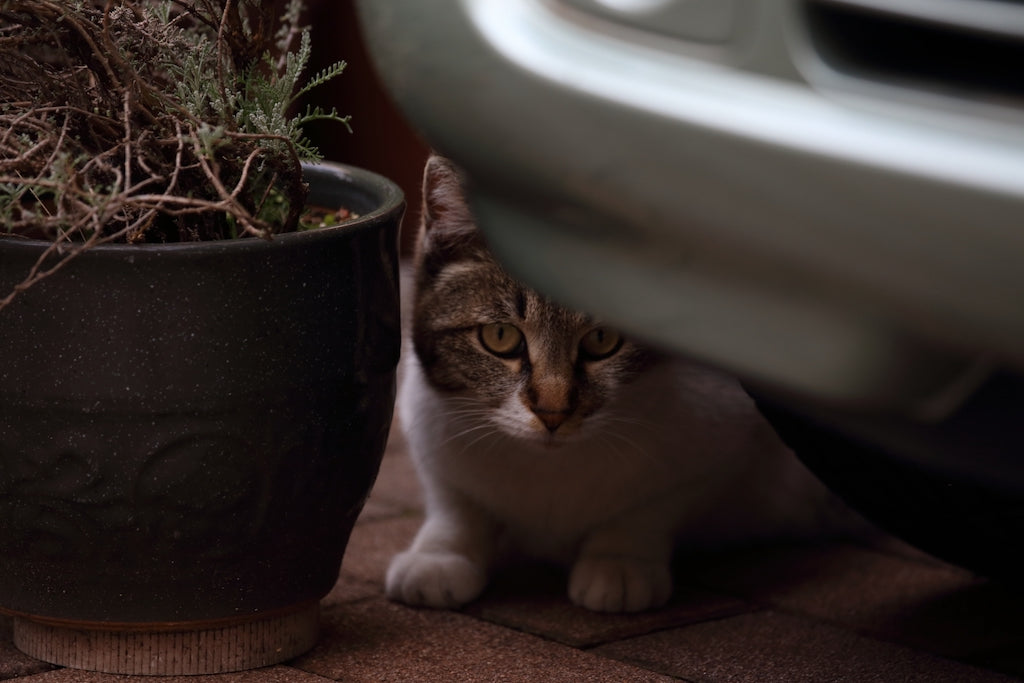
If your cat gets lost during a disaster, how do you find them? I've summarized the actions to take when your beloved cat escapes or gets lost.
Search near your home
Immediately after an escape, if your safety is secured, first try searching near your home.
If your cat is an indoor-only cat, they won't go very far. Search within a 50-meter radius in places where they might hide, such as under sheds, in ditches, or under air conditioner outdoor units.
Additionally, place items with your cat's scent, such as used cat litter or their favorite blanket. If they smell their own scent, they might return closer. Call their name in your usual calm tone.
Even if you find your cat, don't chase them. To avoid panic, prepare their usual carrier bag or a cardboard box with a hole in it, and gently guide them to return voluntarily.
|
【Related Articles】 |
File a lost pet report
If you can't find them, expand your search radius to 100m, then 500m, and file a lost pet report with the public health center or animal welfare center, and the nearest police box or police station if they are operational.
The Lost Pet.NET list of reporting locations page is useful, so please note the information for your area. You can also check for information on protected cats, so if lifelines are active, check search sites as well.
It's also possible that they've been taken in by a veterinary hospital due to injury, or sadly, picked up by the sanitation department if they've passed away, so you should inquire there as well.
Gathering sighting information
In addition to social media like Twitter and Facebook, you can also use websites that allow you to register lost cats to widely gather sighting information and request assistance with the search.
Also popular is the app "Dokonoko" which has a function to ask nearby users to help search for lost pets.
We recommend installing the "Lost Pet Search Manual," supervised by pet detective Fujiwara-san, on your smartphone.
Prepare for "what if" with lost cat measures
During a disaster, government agencies and lifelines can be in chaos. It's possible that not everything will be functioning, so prepare for what to do if your cat gets lost.
Compile your cat's information
When searching for a lost cat, you will need your cat's individual identification information.
Individual identification information refers to your beloved cat's photos, breed, fur color, physical characteristics, name, gender, collar color and features, favorite treats and toys, and the microchip's individual identification number.
It's reassuring to compile this information in a "cat health record book" and keep it with your cat's disaster preparedness kit. Furthermore, it's convenient to take photos and store them on your smartphone or in cloud services like Google Drive.
Take pictures of your beloved cat
During the Great East Japan Earthquake, power outages continued, so information on protected animals and lost pets was reportedly exchanged via handwritten posters.
In preparation for such a situation, take pictures of your cat regularly and print them out. It would also be good to have pictures with the owner to clearly identify ownership.
|
【Related Articles】 |
Summary
In this three-part series, we've discussed how to protect your cat's life during a disaster.
First and foremost, "preparation" is key. This includes preparing disaster supplies for your cat, as well as getting them used to cages and harnesses in anticipation of shelter life.
You should also be aware of what is necessary for "evacuation with pets." While how cats are handled may vary by shelter, shelter life cannot be sustained without cooperation among pet owners.
Furthermore, "measures for lost pets" during a disaster are essential. Cat collars and microchips serve as identification for cats, so be sure to use them. I also hope you'll remember how to search for a lost cat.
The Great East Japan Earthquake raised awareness of disaster preparedness for pets. Over the past decade, I believe that both the "hardware" and "software" aspects of pet disaster preparedness have greatly improved.
Nevertheless, during a disaster, only the owner can protect their cat's life.
What should you prepare, and how should you act? Let's think about what to do in an emergency so you can overcome difficulties together with your cat.
|
[Related Articles] |

![Poponeko Selected as Furusato Nozei Gift [Toride City, Ibaraki Prefecture]](http://www.poponeko.jp/cdn/shop/articles/010f7540ce751ae3bb42785d6423e019.jpg?height=400&v=1765802143)

![[Written by a Veterinarian] How to Work in an Animal Hospital: Essential Qualifications, Job Responsibilities, and Traits of Suitable Candidates](http://www.poponeko.jp/cdn/shop/articles/shutterstock_2399480085.jpg?height=400&v=1755261095)
![[Slightly Imperfect] Cat-Friendly Skin Protection Suit (Coverall) for Cats](http://www.poponeko.jp/cdn/shop/files/DSC05845.jpg?v=1769403729&width=600 "[Slightly Imperfect] Cat-Friendly Skin Protection Suit (Coverall) for Cats")
![[Set Product] Leaf Ribbon & Cat Collar - Champ de Fleurs Mustard](http://www.poponeko.jp/cdn/shop/files/DSC00104_6c37e71d-120f-40d9-a773-9a5b7e885760.jpg?v=1780663183&width=600 "[Set Product] Leaf Ribbon & Cat Collar - Champ de Fleurs Mustard")
![[Set] Leaf Ribbon moda The Fleeting Outdoors & Cat Collar Stain-Resistant Water-Repellent Oil-Repellent Black](http://www.poponeko.jp/cdn/shop/files/260618_00173-2.jpg?v=1784452166&width=600 "[Set] Leaf Ribbon moda The Fleeting Outdoors & Cat Collar Stain-Resistant Water-Repellent Oil-Repellent Black")
![[Set] Leaf Ribbon & Scrunchie Cat Collar - Hannari Cherry Blossom Blue](http://www.poponeko.jp/cdn/shop/files/2608_00139.jpg?v=1789197917&width=600 "[Set] Leaf Ribbon & Scrunchie Cat Collar - Hannari Cherry Blossom Blue")

![[Set] Leaf Ribbon & Scrunchie Cat Collar, Gingham Check, Blue](http://www.poponeko.jp/cdn/shop/files/DSC00092_346b4b0c-da46-4b7b-b5e9-8ab3dafb6534.jpg?v=1780663891&width=600 "[Set] Leaf Ribbon & Scrunchie Cat Collar, Gingham Check, Blue")

Leave a comment